I am bullish on AI, and on the trade behind it. Almost every hard signal points the same way. Rental prices for the newest GPUs are rising, not falling. Memory demand is intact and contract prices are climbing. Token volumes keep compounding. Gavin Baker of Atreides Management put it bluntly: the AI selloff was narratively liquid and factually hollow. He went looking for the bear case, and every quantitative series he tracks, from GPU rents to DRAM spot prices to hyperscaler operating cash flow, is accelerating rather than decelerating. I agree with the diagnosis. When you go to Silicon Valley looking for the reason this all falls apart, you mostly come back with more evidence that it doesn't.
But investing is forward-looking, and we've spent a long time on the bull case. The four largest hyperscalers keep raising their 2026 capex guidance. This quarter Alphabet took its range to $195 to $205 billion and Amazon to about $220 billion; add Meta and Microsoft, and the four are now guiding to comfortably more than $700 billion for the year, roughly double what they spent in 2025. Near all-time highs, that much good news is already in the price. Whether AI demand is real is not the question that pays the bills anymore; the data has settled it. The question is whether the return on the next dollar of capex holds up as the numbers get bigger. Call it a stress test rather than a bubble call: five things that could go wrong. I've put them in rough order of how visible they are today, though macro could just as easily move first.
1. The Free-Cash-Flow Bet
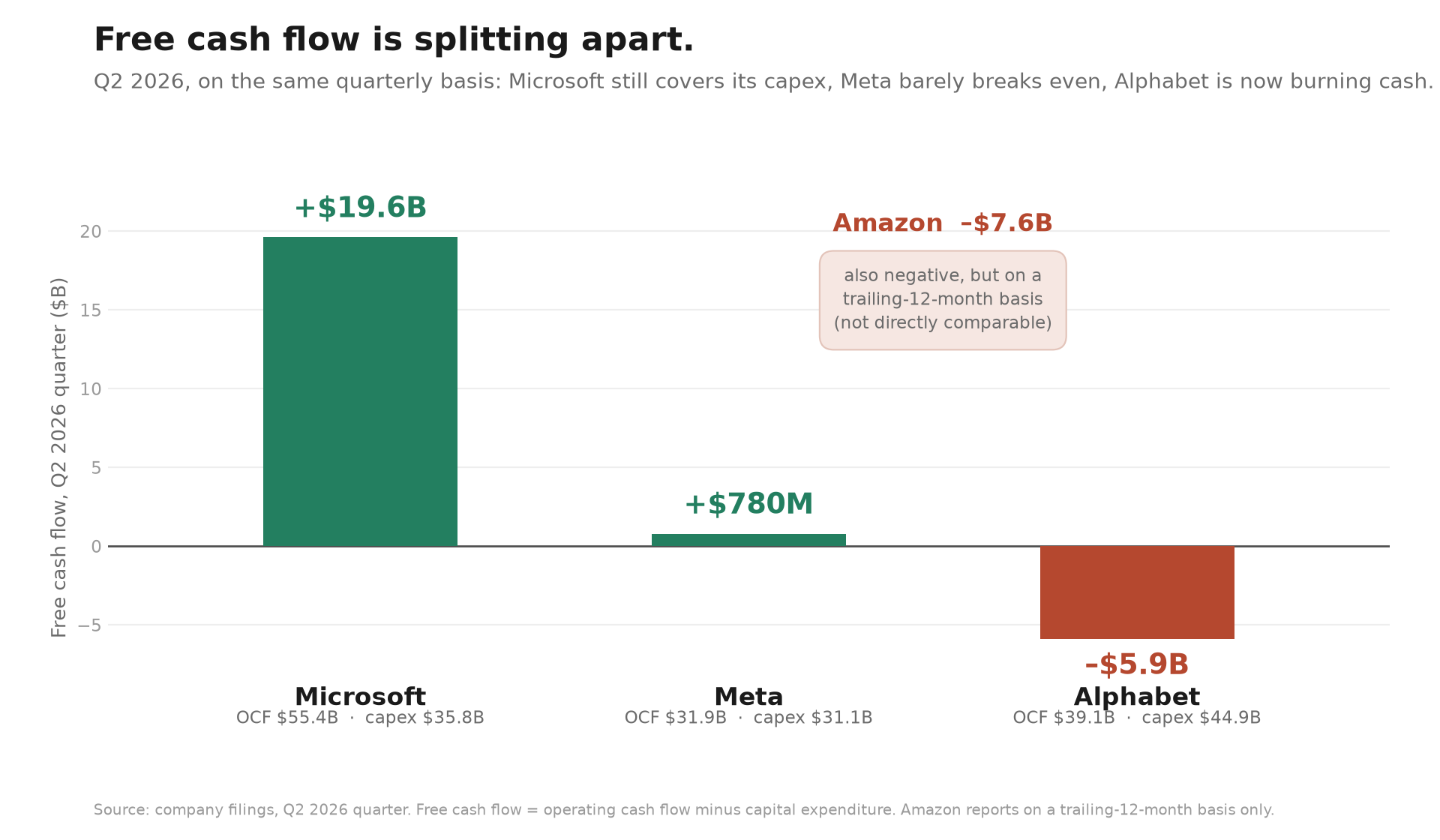
The first crack is already in the prints, not somewhere out in forecast-land. Meta grew revenue 28% last quarter and still watched free cash flow fall to $784 million, from $8.55 billion a year earlier, as quarterly capital spending reached $31.1 billion. The largest technology companies in the world are now spending fast enough that even excellent operating businesses are watching cash conversion compress toward zero. Meta is not alone. Alphabet reported its first negative free cash flow since its 2004 IPO, Amazon's trailing free cash flow has swung negative after three straight years in the black, and Microsoft is now the only one of the four still comfortably covering its capex out of operating cash.
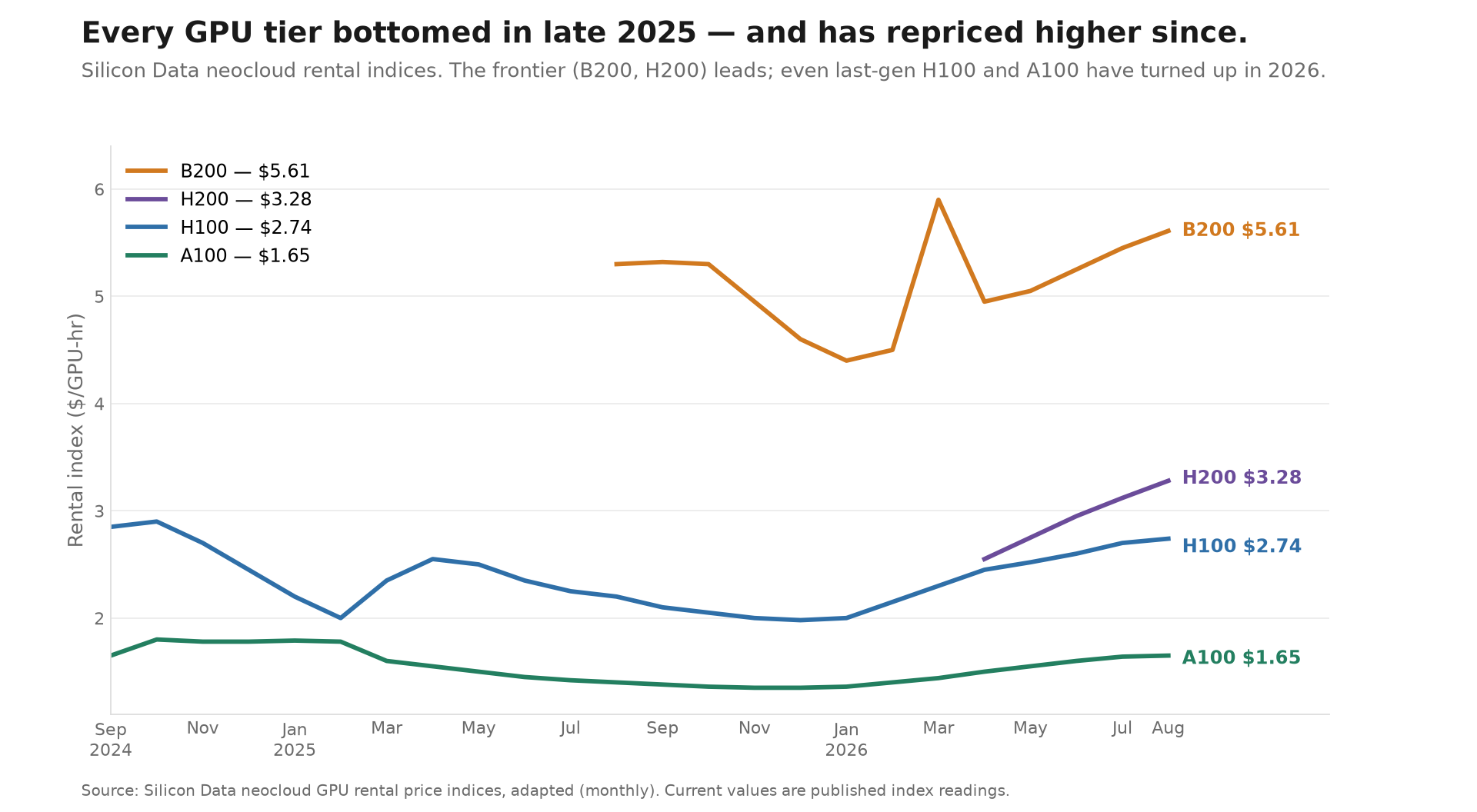
That looks alarming until you see the bet behind it, and the bet is coherent. The hyperscalers are spending cash today against extraordinary compute-rental income tomorrow, and that income is already real, not hypothetical. SpaceX has turned its Colossus data centres into a rental business: Google has reportedly contracted roughly $920 million a month for capacity, Anthropic about $1.25 billion a month for Colossus 1, together more than $2 billion a month in compute revenue from assets that used to be a cost centre. And the price of renting the newest compute keeps climbing. Silicon Data's B200 rental index opened 2026 near $4.40 a GPU-hour, spiked toward $6 in March, and now sits around $5.61, up roughly a quarter on the year. This isn't only a frontier story, either. Every tier bottomed in late 2025 and has repriced higher through 2026, with even last-generation H100 and A100 turning back up, to about $2.74 and $1.65. But the newest silicon, the B200 and H200 that today's capex is actually buying, commands both the highest rents and the steepest increases. If rents hold anywhere near these levels, today's negative free cash flow starts to look like tomorrow's high-margin annuity. Whether the build actually pays back, and how fast, is something the rent alone can't settle: it turns on utilization, depreciation schedules, power and networking costs, financing, and operator margin, none of which a rental index captures. But the direction of the bet is coherent, which is why sophisticated operators run the cash line negative on purpose. It's a calculated bet, not a flinch.
The whole bet rests on those rents staying extraordinary, and today's price is a shortage price. As new power comes online and the next GPU generations ship, supply catches up and the rental economics that justify the spending can normalise. There's a tell buried in SpaceX's own behaviour: it rents its frontier compute out to others rather than using all of it to train its own models, a decision that only makes sense while the rent beats the return it would earn. We don't actually know these prices are sustainable. With Alphabet and Amazon already in the red, the thing to watch is whether the rents hold, and whether Microsoft's cushion gives way so the whole group ends up funding the build with debt instead of operating cash. That's the point where the market starts pricing the bet rather than the buildout.
2. Power is a cost, not a ceiling
Capital can be committed in a press release. Electricity can't, at least not on the same timetable.
Utility interconnection queues in the markets carrying most of the announced 2026 buildout (Northern Virginia, Phoenix, Dallas) now run four to seven years. Long-lead items like high-voltage transformers and medium-voltage switchgear increasingly decide whether a site energises on schedule at all.
But this is a bottleneck, not a wall, and it's worth being honest about why. Capital routes around a shortage; that's what capital does. Rather than wait for the grid, operators are self-generating behind the meter: roughly 77 gigawatts of new gas-fired generation is planned between 2026 and 2033, and fuel cells have gone from niche backup to primary supply, with Bloom Energy alone booking some $7.65 billion of data-centre contracts in a single quarter: Oracle for up to 2.8 GW, AEP for 1 GW on a twenty-year deal. Small modular reactors and solar-plus-storage sit behind that. There's little sign the buildout runs out of electrons in a way money can't solve.
So power doesn't end the trade. What it threatens is the returns, in two ways. Timing: self-generation has its own queues, announced gigawatts aren't energised gigawatts, and a GPU depreciates on the same schedule whether or not there's power to run it. Cost: electrons produced behind the meter are dearer than cheap grid baseload, and that eats straight into the rental margins the first risk depends on. Power won't stop the build. It'll make it later and dearer than the models assume, which is a valuation problem well before it's an existential one.
3. The demand is real, and dangerously concentrated
Every dollar of capex is ultimately a bet that someone buys the intelligence the infrastructure produces. Follow that demand back to its source and it narrows fast.
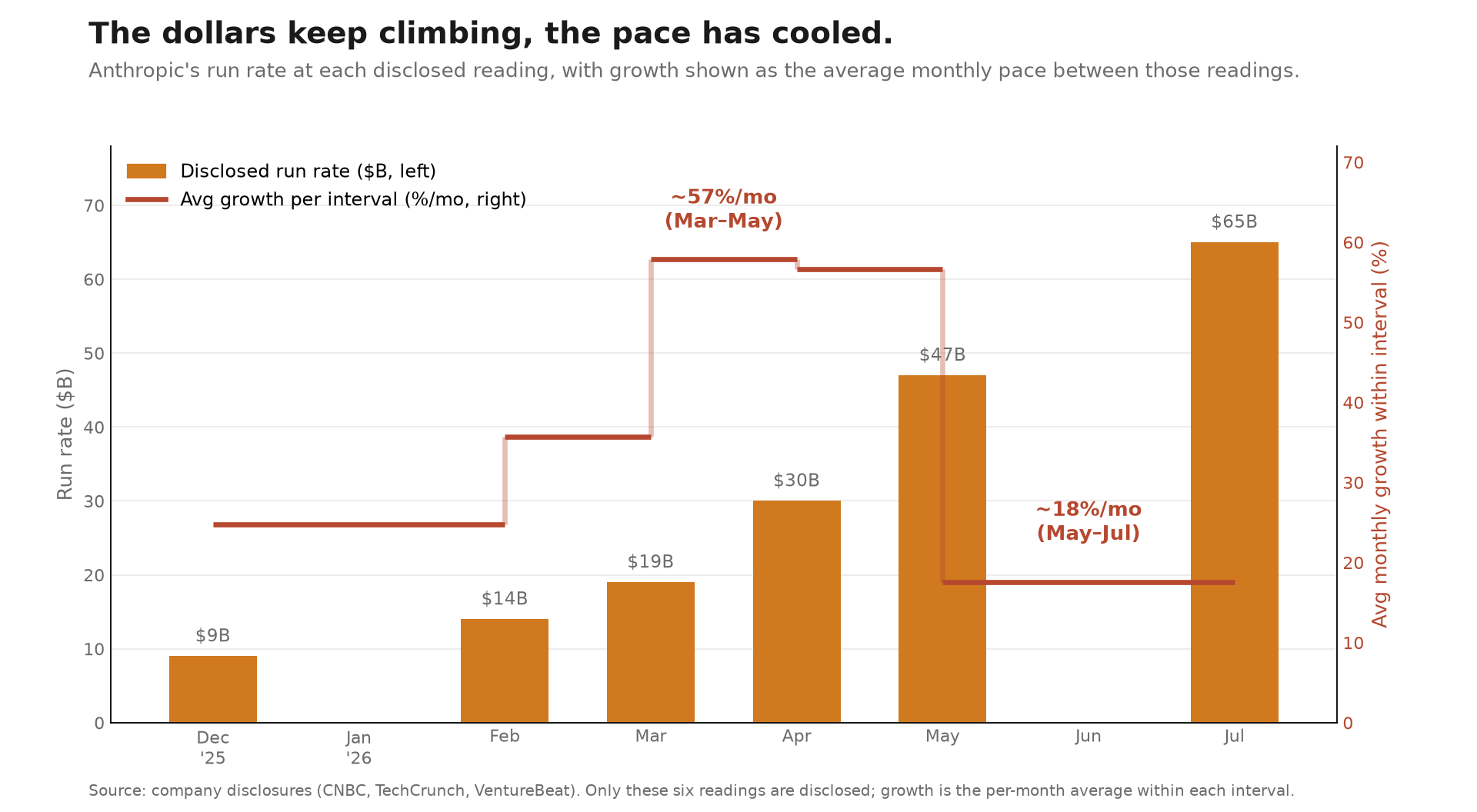
Most of the frontier-model revenue that underwrites the compute cycle sits with two private companies. Anthropic's annualised revenue run rate reached a reported $65 billion in July, up from about $47 billion in May. OpenAI's run rate is reported in the same league, variously around $40 billion. Together that's roughly $105 billion of run-rate revenue, the two of them dwarfing the rest of the model layer and standing in for most of the demand a $700 billion capital cycle is built on. It's a remarkable demand engine, and a remarkably thin one.
Two things follow. First, the demand story underwriting the largest capital cycle in modern technology rests on two firms whose revenue appears on no audited public filing. The visibility investors have into $700 billion of annual spending is a handful of run-rate figures the companies disclose themselves, plus the occasional leaked internal memo. Second, right now those figures are still accelerating. According to a leaked internal memo, OpenAI's CFO told staff in late July that revenue growth had sped up, with the quarter-to-date run rate up around 35% and enterprise revenue overtaking consumer for the first time. That's the bull's evidence, and I count it as such.
But a buildout sized to a growth rate this steep is making an implicit bet that the rate holds, and no revenue line compounds at these percentages forever. Anthropic offers the first hint of how it ends: its run rate is still climbing fast in dollars, from a reported $47 billion in May to $65 billion in July, but between those disclosures the pace has cooled, from roughly 57% a month across the spring to about 18% a month into the summer. Deceleration off a huge base is natural, and not yet a warning. It's just the one input a $700-billion capital plan can't easily absorb if it arrives early, and with demand this concentrated, it would take only one of the two engines to stumble.
4. The Politics of the Buildout
The slower throttle on the buildout is political, and over the past few months it's stopped being hypothetical.
Data centres have gone from a local zoning nuisance to a midterm campaign issue. The reason is the electricity bill. As data-centre load competes for constrained power, residential rates rise (some regions are seeing annual increases of more than 25%), and rising bills have become a centrepiece of the 2026 "affordability" fight. Polling now shows a plurality of voters across party lines viewing data-centre expansion as a direct threat to what they pay for power. That is a rare bipartisan grievance in a divided electorate, and candidates have noticed. Analysts flag AI-data-centre backlash as a threat to Republican incumbents in Pennsylvania toss-up districts; governor's races in states including Texas are being reshaped by it; and the policy tools on the table (construction moratoriums, new data-centre taxes, and "large-load" utility tariffs designed to push the cost of new capacity onto the data centres themselves) each raise the cost or slow the pace of the build.
And the bill is only half of it. The other half is physical and environmental, and it is often what actually mobilises a town. The fights are increasingly about water as much as watts: US data-centre water use is on track to climb from under 20 billion gallons a year toward 60 to 110 billion by 2030, and in the drought-exposed markets that carry much of the build, Phoenix and parts of Texas, that sets cooling towers directly against farms and households. Layer on the air-quality politics of the behind-the-meter gas turbines the build is leaning on, plus the truck traffic, noise, and light of a hyperscale site, and local opposition has found a template that works. In the first quarter of 2026 alone, community campaigns helped cancel roughly 20 proposed projects worth about $41 billion, and as organisers point out, it is far easier to rally a town against a project than to rally one for it.
None of this stops the buildout; it raises the price and adds a layer of approval risk that didn't exist when the sites were smaller and the load invisible. A single high-profile moratorium in a key market, or "your power bill went up so a data centre could run" turning into a winning line in November, hits sentiment well before it hits the numbers. That's usually the order these things arrive in.
5. The Tail Risk Is Macro
None of the first four risks breaks the AI trade on its own timetable. What could turn a slow re-rating into a fast one is the macro backdrop, and the deepest risk there isn't oil or an election. It's the long end of the bond market.
The 30-year Treasury yield touched 5.31% in mid-August, its highest in nineteen years, on a federal deficit now locking in above $2 trillion and the relentless issuance that funds it. This matters to the AI trade more than to almost anything else, for two reasons that compound. First, AI infrastructure is the longest-duration asset in the market (its returns sit years out), so it's the most sensitive of all to the rate used to discount them; a higher long end compresses these valuations first and hardest. Second, the buildout is no longer self-funded. Across the five biggest spenders (the four hyperscalers plus Oracle), the share of capex covered by incremental debt has already climbed from about 9% two years ago to roughly a third in the year to mid-2026, so the same rising yields lift the cost of the build even as they compress its valuation. And there's a reflexive twist: that wave of AI-related issuance is itself part of what's pushing the long end higher. Rates raise the cost of the trade; the trade raises rates. That loop, not any single headline, is the macro risk I watch most closely.
Oil sits on top of this as a two-way catalyst, not the core of it. Crude has round-tripped from the $60s to about $91 as the US-Iran ceasefire expired and the Strait of Hormuz stayed choked, though a single Trump-Iran headline could send it back down as fast as it rose. What matters is the impact: oil moves inflation, inflation moves the long end, and the long end is what prices AI. The calendar doesn't help. August and September are historically the weakest stretch of the year for equities, and a US midterm in November stacks political uncertainty on top. Neither triggers a selloff on its own, but both can deepen one already under way.
The danger isn't that macro invalidates AI. It's that the trade is levered and concentrated, so a wobble doesn't stay a wobble. Late in July, a single AI-focused fund running borrowed money against illiquid private stakes was forced to unload roughly $20 billion of stock over about 30 hours when its lender wanted cash, selling the liquid pieces of a multi-year theme at the worst possible moment. The fund's specific positions don't matter here. The mechanism does: leverage plus concentration turns "I'd like to sell" into "I have to sell," and a crowded, debt-financed trade is loaded with both. Macro just lights the fuse.
What would tell you a risk is turning real
Each risk has a tell worth tracking:
- Cash: Microsoft's free cash flow following Alphabet and Amazon into the red, or capex funded by new debt, and any sign that compute-rental prices have stopped rising.
- Power: a widening gap between announced gigawatts and energised gigawatts, and further slippage in the 2026 pipeline.
- Demand: the first sign that Anthropic's or OpenAI's sequential growth is normalising rather than compounding.
- Politics: a marquee permitting rejection, a state moratorium, a water-permit denial in a drought market, or a data-centre "large-load" tariff becoming law.
- Macro: a further break higher in the 30-year yield or a widening in investment-grade credit spreads. That's where a shock, oil included, shows up before it hits the trade.
I remain long. The buildout is real, the demand is real, the compute rents are rising, and the spending is still climbing. The bull case is intact, and when you go looking for the case against it, the data mostly refuses to cooperate. But a trade this large and this crowded doesn't break because the bear case is true today. It breaks when one of these risks moves from hypothetical to visible while everyone is still staring at the capex line. That's what a forward-looking investor near all-time highs is watching for.
This is analysis, not investment advice. Figures move quickly and several (private-company run rates especially) are self-reported or estimated; recheck before relying on them.
Sources
- Gavin Baker on the AI selloff and accelerating demand signals - BigGo Finance: https://finance.biggo.com/news/313ad11fa89bcaaa
- Hyperscaler 2026 capital guidance and Meta Q2 free cash flow - Meta Investor Relations: https://investor.atmeta.com/investor-news/press-release-details/2026/Meta-Reports-Second-Quarter-2026-Results/
- Microsoft the only US hyperscaler with positive free cash flow; Alphabet and Amazon turn negative - Investing.com: https://www.investing.com/news/stock-market-news/microsoft-only-us-hyperscaler-with-positive-free-cash-flow-as-ai-capex-bites-93CH-4846663
- Amazon Q2 2026 free cash flow turns to a ~$7.6B trailing-12-month outflow on record AI spending - GeekWire: https://www.geekwire.com/2026/aws-is-booming-but-amazons-free-cash-flow-turns-negative-on-record-ai-spending/
- Microsoft Q4 FY2026 (June quarter): operating cash flow $55.4B, cash capex $35.8B, free cash flow $19.6B - CNBC: https://www.cnbc.com/2026/07/29/microsoft-msft-q4-earnings-report-2026.html
- Alphabet Q2 2026: free cash flow -$5.9B (first negative on record), capex $44.9B, 2026 guide lifted to $195-205B - Search Engine Journal: https://www.searchenginejournal.com/google-q2-earnings-show-5-85-billion-negative-free-cash-flow/583259/
- Four-hyperscaler 2026 capex guidance (~725B; 750B including Oracle) - Value Add VC AI Spending Tracker: https://valueaddvc.com/ai-spending
- SpaceX Colossus compute-rental business and the Google capacity deal - Fortune: https://fortune.com/2026/07/19/spacex-ai-compute-renting-business-google-anthropic-pentagon-deals-revenue-valuation-elon-musk-colossus-data-centers/
- Anthropic's $1.25 billion/month Colossus 1 lease - ActuIA: https://www.actuia.com/en/news/anthropic-rents-colossus-1-for-125-billionmonth-on-an-xai-park-capped-at-11-capacity/
- B200 and H100 rental price indices (SDB200RT, SDH100RT) - Silicon Data: https://www.silicondata.com/products/silicon-index/b200
- Grid interconnection queues, the electrical-layer bottleneck and gas-turbine buildout - Silicon Report: https://siliconreport.com/ai-datacenter-power-crunch-electricity-bottleneck-31b33b49
- Fuel cells as primary data-centre power; Bloom Energy's $7.65B of contracts (Oracle, AEP, Brookfield) - DCD: https://www.datacenterdynamics.com/en/news/bloom-energy-signs-5bn-partnership-with-brookfield-to-deploy-fuel-cell-tech-across-ai-data-centers/
- AI data-center backlash and the 2026 midterms - CNBC: https://www.cnbc.com/2026/04/24/ai-data-centers-pennsylvania-republicans-2026-election.html
- How rising electric rates could affect the 2026 midterms - Brookings: https://www.brookings.edu/articles/how-rising-electric-rates-could-affect-the-2026-midterms
- Data-centre water consumption on track for 60-110 billion gallons/year by 2030 - EESI: https://www.eesi.org/articles/view/data-centers-and-water-consumption
- Local opposition helped cancel ~20 data-centre projects (~$41B) in Q1 2026 - S&P Global: https://www.spglobal.com/energy/en/news-research/latest-news/electric-power/012926-data-center-opposition-gains-momentum-as-power-demand-spikes
- Anthropic annualised revenue run rate reaches $65 billion in July - CNBC: https://www.cnbc.com/2026/08/17/anthropic-says-annualized-revenue-climbed-to-65-billion-in-july.html
- OpenAI 2026 revenue run rate - Value Add VC: https://valueaddvc.com/blog/openai-revenue-2026-25b-arr-2b-month-and-the-path-to-profitability
- OpenAI CFO says revenue growth accelerated in July (quarter-to-date run rate up ~35%, enterprise overtakes consumer) - The Information: https://www.theinformation.com/briefings/openai-cfo-says-revenue-growth-accelerated-july
- Oil prices rise as the US-Iran ceasefire ends with no deal - The Hill: https://thehill.com/policy/energy-environment/5960020-iran-ceasefire-gas-prices-strait-of-hormuz/
- 30-year Treasury yield at a 19-year high on deficits, AI issuance and term premium - CNBC: https://www.cnbc.com/2026/08/18/us-government-debt-yields-are-surging-at-a-bad-time-heres-whats-behind-the-move.html
- Hyperscaler capex increasingly debt-funded: incremental debt up from ~9% of capex (FY24) to ~32% LTM by mid-2026, across the five biggest spenders including Oracle - FactSet Insight: https://insight.factset.com/hyperscalers-tap-external-financing-as-ai-capex-outruns-cash-flow
- Situational Awareness forced liquidation and Citadel transaction - The New York Times: https://www.nytimes.com/2026/07/30/business/artificial-intelligence-situational-awareness-citadel.html
- NVIDIA Q2 FY27 financial-results event (August 26) - NVIDIA Investor Relations: https://investor.nvidia.com/events-and-presentations/events-and-presentations/event-details/2026/NVIDIA-2nd-Quarter-FY27-Financial-Results/default.aspx