
Micron gave investors almost everything they could ask for.
Record revenue. Record adjusted margins. Rising memory prices. AI demand still pulling supply tight. A guide that said the shortage was not ending next quarter. If you wanted a clean earnings print for the AI infrastructure trade, this was close.
And then the stocks started to wobble.
By mid-July, the wobble had become a correction. The high-beta end of the AI trade broke: Micron fell double digits, AMD dropped hard, and the memory complex, neoclouds, and levered AI-adjacent names all got hit, even as memory pricing data still pointed up. There were headlines to point at, among them a report that Meta is exploring turning surplus AI compute into a business, which would put a hyperscaler on the sell side of the capacity market. But the selling was broader than any single story.
Then it got stranger. In the same week the correction deepened, the two most upstream companies in the AI supply chain reported the best numbers of the cycle. TSMC posted a record $40.2 billion quarter, up 36% year over year, and raised its 2026 revenue-growth outlook from above 30% to slightly above 40%, reflecting continuing AI-accelerator demand. ASML beat its own guidance, called first-half order intake "extremely strong," and said 2027 EUV demand is nearly fully booked while it expands capacity 30%.
The market sold TSMC anyway. The best earnings report in the company's history, and the stock closed lower despite the results.
Accelerating fundamentals. Falling stocks. That is the useful moment to study: not when the story is broken, but when the story is working and the stocks stop caring.
The question everyone reaches for is: "Is AI a bubble?"
The more useful question is: what kind of bubble are we looking at? Because bubbles do not usually break because the story is false. The harder version is when the story is true and the stocks have already discounted too much perfection.
My read: AI today looks like the 1920s electricity boom in the buildout and the financing, dot-com in the valuation, running at 2021 speed.
Not a clean bearish call. Something more uncomfortable. The infrastructure can be useful and the stocks can still be overloaded.
The Good News Sold Off
Start with the tape, because the sequencing is the tell.
Early in a cycle, good news gets underpriced. The market is skeptical. Every data point forces investors to raise numbers.
Then comes the middle. The thesis becomes consensus. The same good news still works, but less violently.
Then comes the fragile part. Good news becomes expected. Beats are treated as table stakes. The stock no longer responds to the print; it responds to positioning, valuation, and whether the next buyer still exists.
July compressed all of that into two weeks: the best cluster of AI data points this year met selling in the most crowded expressions of the trade.
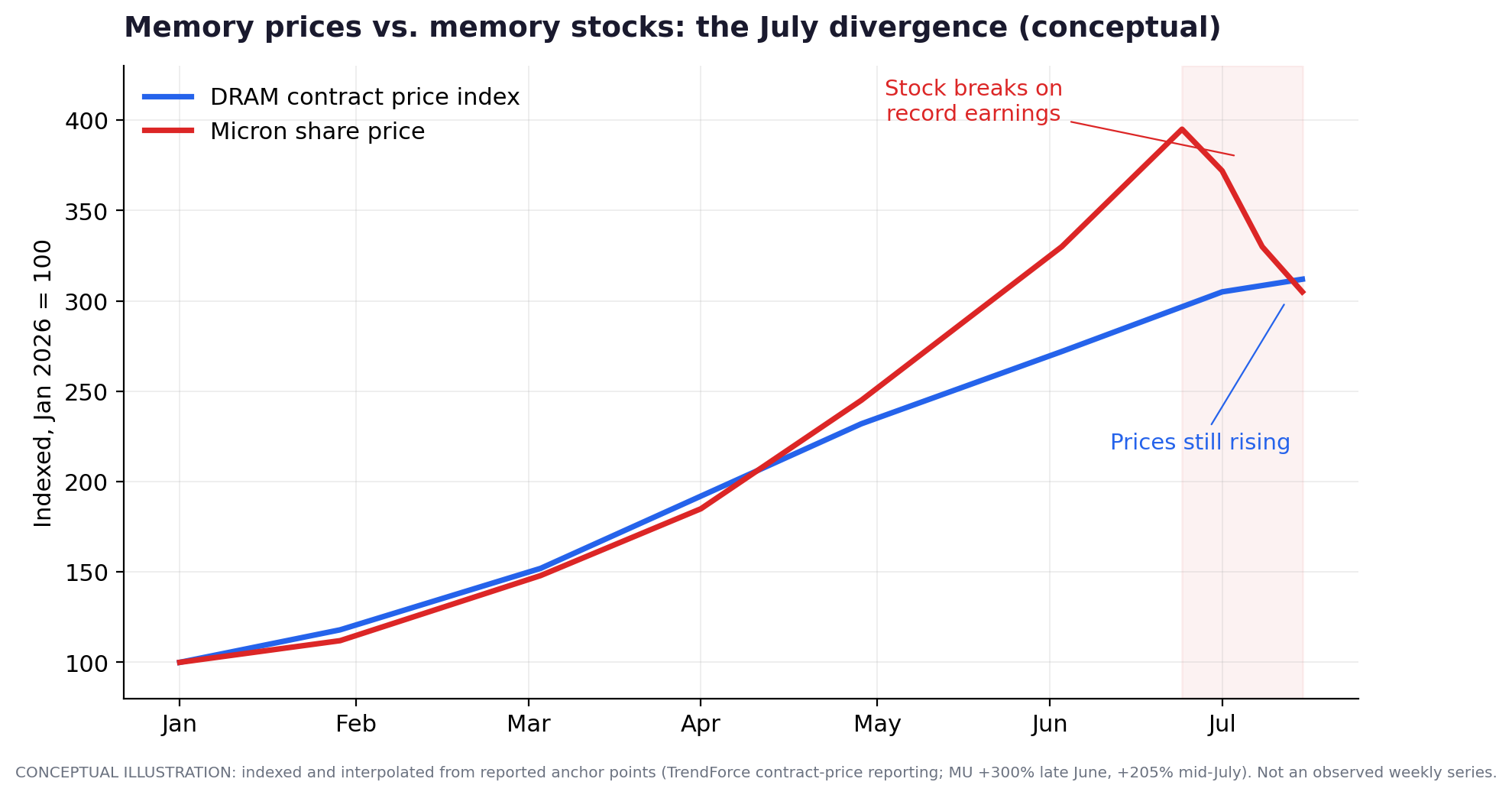
The top may not be in. The easy phase is gone.
This is where history helps, not as a template but because every major bubble has a different failure mode.
Electricity: The Boom That Was Right and Still Ruined People
The best historical analogy for AI is not railways, and it is not a generic "1929." It is the electrification of America in the 1920s, because it is the one prior episode that combines a real general-purpose technology, a massive physical buildout, and a financing layer that collapsed anyway.
Electricity in the 1920s was everything AI claims to be now. It rewired factories and lifted productivity across the whole economy. It created new industries: appliances, radio, mass entertainment. Its infrastructure required enormous, multi-year capital commitments. Utilities were the growth stocks of the decade. RCA, the era's defining technology stock, was its Nvidia.
The buildout was real. Generating capacity, transmission lines, and electrified homes all compounded through the decade. Nobody was wrong about electricity.
What failed was the wrapper. Utility holding companies stacked leverage into pyramids. Samuel Insull's empire controlled operating utilities across dozens of states through layer upon layer of thinly capitalized holding companies, each borrowing against the equity of the one below. Retail investors bought utility shares and bonds on margin because prices had made caution look stupid for too long. When the market turned in 1929, falling prices forced selling, forced selling collapsed the pyramids, and the pyramids took the savings of millions with them. Insull's empire failed in 1932. RCA fell roughly 98% from its peak and did not reclaim it for three decades.
Here is the detail that matters most: even the technology was not immune. Electricity consumption fell with the economy from 1929 to 1932. What survived was electrification itself, which resumed and kept transforming the economy for decades. What never came back was the financing structure built on top of it. The technology's future was intact; the leveraged owners of it were destroyed anyway.
Map that onto today. The core AI spenders are not Insull pyramids; Microsoft, Google, Amazon, and Meta fund capex from real cash flow. But the 1920s layer exists in modern form. FINRA margin debt hit $1.42 trillion in May. The nominal record matters less than the rate: up 54% in a year, far faster than the market grew, and by one estimate a larger share of GDP than at the 2021 peak. What the aggregate cannot show is how much of that leverage sits under AI names; that opacity is itself part of the risk. Add neoclouds financed against GPU collateral and circular deals where suppliers fund their own customers' demand. Leverage does not need to sit on hyperscaler balance sheets to matter. If one theme carries an unusually large share of index performance, leverage underneath that theme turns "I want to sell" into "I have to sell."
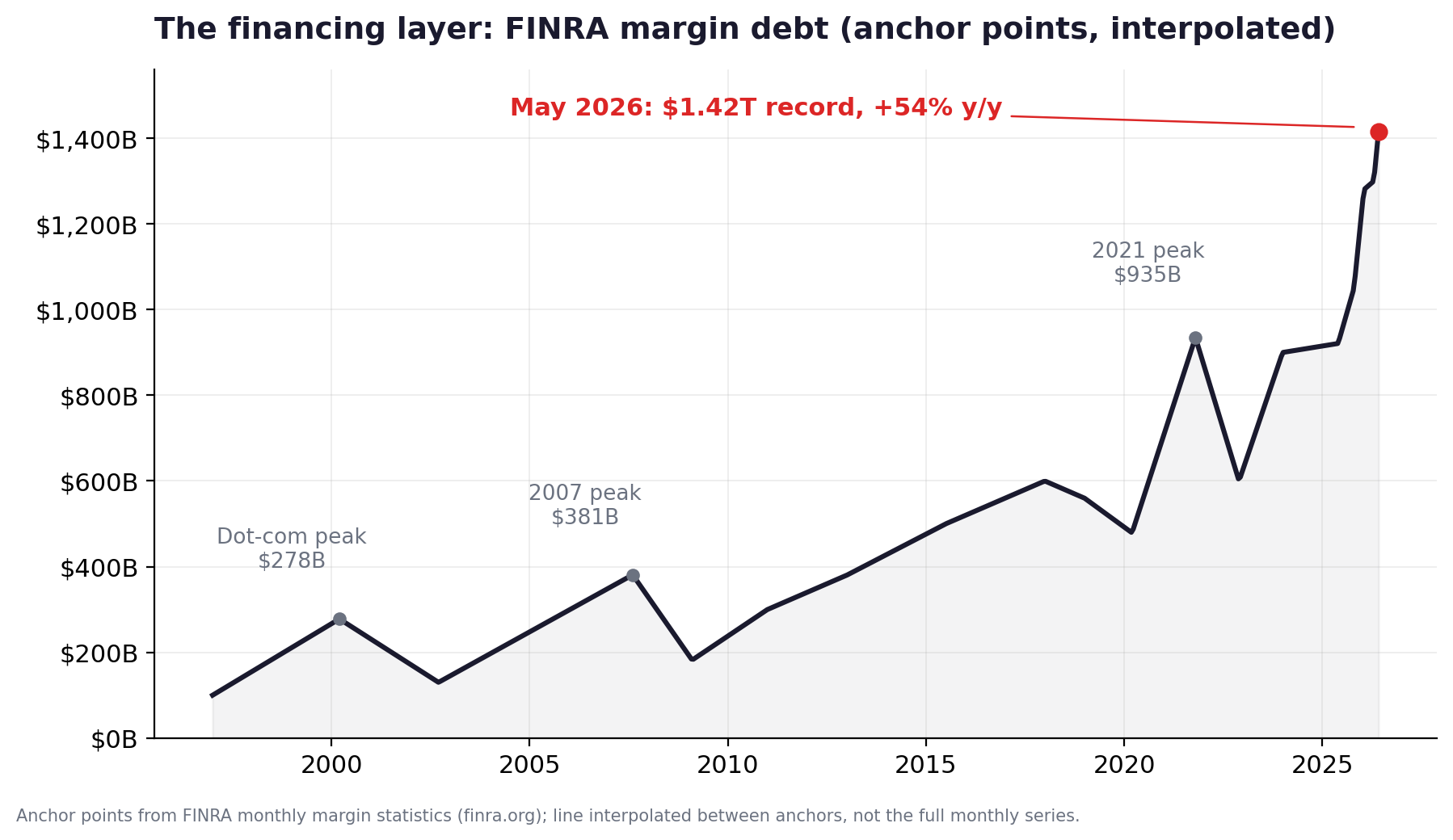
The electricity lesson is simple: watch the financing layer, not just the fundamental story.
The servers may be useful. The margin account does not care.
Dot-Com: The Valuation Trap
The lazy dot-com comparison is that the internet was fake.
That is wrong. The internet was real. The fiber was real. The routers were real. Cisco was real. Amazon was real. The problem was that the market pulled too much of the future into present valuations.
The AI buildout is not made of vapor either. Data centers are being built. GPUs are being installed. Memory is being pre-bought. The capex is visible in steel, copper, silicon, and substations, and now in TSMC's wafer revenue and ASML's order book.
The danger is real AI carrying too much market weight.
In 2000, the market found every tollbooth on the internet and priced it as if traffic would arrive instantly, margins would stay high, and competition would not matter. Some infrastructure survived and became foundational. Many equity holders did not.
The same trap applies now. Micron can be a real beneficiary of AI and still be a dangerous stock at the wrong price. SK Hynix can sell out HBM capacity and still see its multiple compress before earnings peak.
The dot-com lesson runs the other way from the comfortable version: real technology enables better bubbles, because it gives investors something true to hold onto.
And one layer of 2021 deserves a quick mention, because it is the piece neither historical episode had: speed. The meme-stock and software bubble of 2021 showed that options, passive flows, and social coordination can compress a full hype cycle into months and an exit into days. Electricity took a decade to overbuild and three years to unwind. Dot-com took five years to inflate and two to deflate. The current market combines old-economy capital intensity with an exit door everyone can see at once. The physical cycle is multi-year. The market cycle can turn in a week. July just demonstrated it.
The Scorecard
Side by side:
| Dimension | 1920s electricity | Dot-com | AI today |
|---|---|---|---|
| Core technology | Real, transformative | Real internet | Real AI infrastructure |
| Buildout | Massive, multi-year, productive | Fiber overbuild, capex ahead of revenue | Data centers, fabs, power; accelerating |
| Main excess | Leverage pyramids on real assets | Valuation pulled decades forward | Both, in pieces |
| Buyer quality | Retail on margin, holding companies | Weak (CLEC-style, vendor-financed) | Hyperscalers strong; speculative layer weak |
| Speed of unwind | Years | Two years | 2021-style, potentially weeks |
| Failure mode | Financing collapse; electrification stayed strategically valuable, demand initially fell | Multiple collapse; infrastructure survived | Supplier de-rating; speculative layer breaks first |
No single column matches. AI rhymes with electricity on the buildout and financing, with 2000 on valuation, and trades at a speed neither era knew.
Why Memory Is the Cleanest Test Case
Memory is the cleanest place to watch this because the fundamentals are unusually visible.
In software, AI monetization can be fuzzy. In memory, the mechanism is physical: AI racks need more memory, HBM consumes wafer capacity, conventional DRAM gets squeezed, prices rise, margins expand, earnings explode. Micron's quarter translated the AI bottleneck into an income statement.
But memory also has the classic cyclical trap: the stocks often look cheapest when earnings are near peak. The bull case has moved from "memory is underappreciated" to "this cycle lasts longer than the market still fears." That is a narrower and more fragile claim. If MU falls while DRAM and NAND pricing keep rising, the debate has changed: from whether the shortage exists to whether the shortage is enough.
ASML's print sharpened the far end of that question, with a caveat: its planned 30% EUV capacity expansion is tool output across all customers and end markets, not memory supply as such. The direct measure is memory-maker capex and bit-supply growth. But the direction is clear: the tools for the next wave of supply are being ordered, and how much of it lands in DRAM and HBM fabs by 2027 is the variable that decides how long the shortage stays structural.
So Is This a Buy-the-Dip Moment?
Here is the honest framework rather than a clean answer.
What the dip-buyer is betting on. The correction reads as positioning-driven, not demand-driven. The selling started around headlines, none of which changed a fundamental data point, and the upstream fundamentals accelerated straight through it: TSMC raising its revenue-growth outlook to slightly above 40% on AI-accelerator demand, ASML booked into 2027, memory pricing still rising. On this reading, July is digestion after a huge run, the kind of mid-cycle scare that 1998 and late 2018 rewarded, when the underlying cycle was intact and the selling was about crowding, not demand.
What history warns. Both analogies say the most dangerous dips are the ones that arrive after the thesis is proven and fully owned. Utility stocks rallied off their first break in 1930 before losing most of their value. Cisco looked cheap in late October 2000, about 40% off its March high, with fundamentals still fine. It then fell another eighty percent as the multiple, not the earnings, unwound. A proven story at peak ownership looks identical to a mid-cycle pause on the day you have to decide. Price alone cannot distinguish them.
How to split the difference. The layers are not equally risky, and the electricity episode is the guide. Buying the technology's infrastructure with visible multi-year backlog, the TSMC and ASML layer, is a different proposition from buying the financing wrapper: the levered neoclouds, the circular-financed demand, the names whose equity is a claim on continued perfection. In 1930s terms, the first is buying General Electric; the second is buying Insull certificates. Both fell in the crash. Only one was still worth something after.
My lean. Momentum unwind. The Meta compute report made a convenient headline, but the balloon was the crowding itself: margin debt growing 54% in a year under the most concentrated leadership in decades. And the unwind has a scheduled test: the hyperscalers report within weeks, and TSMC's raised guide reflects orders already visible at the foundry. That is strong evidence about demand, though it validates TSMC's order book, not each customer's capex intent or the returns on the spend. If the guides confirm or increase, the momentum-unwind read gets its confirmation, and good news has its best chance of starting to work again. Until then, this is a hypothesis with a date on it, not a call.
The honest risk. Three things could break that lean. The bar: TSMC just proved a record beat alone does not work, so in-line capex confirmation may not either; the guides need to address the flattening fear directly. The framing: Meta's call is one to watch. A real resale product alongside rising capex would improve Meta's own return-on-capex story; it would test neocloud pricing only if it competed for the same third-party workloads. For now, Meta is also a major neocloud customer: Nebius has $12 billion of dedicated Meta capacity and a further $15 billion backstop for capacity it cannot sell elsewhere. "Efficiency" language around Meta's plans would read as retrenchment dressed up. And leadership: violent corrections often resolve with rotation, and the bid can return to the trade without returning to the same names at the same multiples.
The signal that decides it. Watch whether good news starts working again. The first test already failed: TSMC's record print was sold, and the Nasdaq's 3% gap-down was bought back intraday, with semis and memory leading, only to be sold again at resistance. That two-way violence is what a market deciding between digestion and distribution looks like. No single item calls the turn. Look for a cluster:
| Signal | Digestion | Distribution |
|---|---|---|
| Reaction to good news | Next beat or pricing print gets bought | Positive data still gets sold |
| Rally structure | Bounces broaden and hold above the July low | Old leaders bounce hard, fail at lower highs |
| Hyperscaler capex and utilization | Capex holds or rises; AI usage and revenue keep catching up | Capex moderates; capacity resale broadens and competes for third-party workloads; monetization questions deepen |
| Financing layer | Leverage stabilizes; neocloud funding holds | Credit tightens; GPU collateral or neocloud stress forces selling |
If the digestion column fills in, the dip was a momentum unwind and the trade resumes. If the distribution column fills in, the correction is information, not opportunity.
The most dangerous bubbles are not built on lies. They are built on truths that get over-owned.
AI is true. The July earnings proved it again.
The question the dip forces is whether it is still under-owned anywhere, and the answer differs by layer.
What I Am Watching
1. Hyperscaler capex guidance. The first flat-to-down year-over-year guide from a major AI spender would matter more than any consumer-demand noise. TSMC's raised outlook is corroborating evidence that demand has not blinked, not direct proof of any hyperscaler's order book. Their own calls this month either confirm the read or cut across it.
2. The financing layer. Record margin debt is not a timing tool; a reversal after a record run is closer to one. Neoclouds, levered AI-adjacent names, and circular-financed demand should break before the strongest hyperscalers do. Watch them as the modern holding-company layer.
3. Meta's compute plans. Still a report, not a product. Meta remains a major neocloud customer, including at Nebius. If it launches a real capacity-resale business against the same third-party workloads, neocloud pricing and renewal economics get tested; that is a longer-dated risk, not an obvious threat to current contracted revenue.
4. The 2027 supply collision. Watch memory-maker capex announcements and bit-supply forecasts, not just ASML's tool capacity. If new DRAM and HBM supply ramps into even modest demand deceleration, the "structural shortage" story can turn faster than investors expect.
The servers may be useful for years.
The stocks do not get that long to prove it.
This is analysis, not investment advice. Figures move quickly; recheck market data, margin debt, memory pricing, and the correction's magnitude before publication.
Sources
- Micron Q3 FY2026 results and guidance - Investopedia / company reporting: https://www.investopedia.com/micron-earnings-q3-fy2026-memory-stock-soars-ai-demand-12006096
- Meta reported to be exploring selling surplus AI compute - TechCrunch: https://techcrunch.com/2026/07/01/meta-like-spacex-looks-to-turn-excess-ai-compute-into-cash/
- Nebius-Meta infrastructure agreement: $12B dedicated capacity plus up to $15B for unsold capacity - Nebius: https://nebius.com/newsroom/nebius-signs-new-ai-infrastructure-agreement-with-meta
- Memory stocks selling off despite the AI boom - 24/7 Wall St.: https://247wallst.com/investing/2026/07/16/if-the-ai-boom-is-so-strong-why-are-memory-stocks-crashing/
- TSMC Q2 2026 results - TSMC investor relations: https://investor.tsmc.com/english/quarterly-results/2026/q2
- TSMC raises 2026 revenue-growth outlook to slightly above 40% - AP: https://apnews.com/article/ba05b1b952257d371acb9d070e7914ff
- TSMC Q2 2026 slides: record margins, HPC surges 20% q/q - Investing.com: https://www.investing.com/news/company-news/tsmc-q2-2026-slides-ai-demand-drives-record-margins-hpc-surges-20-93CH-4794789
- ASML Q2 2026 results release: https://live.euronext.com/en/products/equities/company-news/2026-07-15-asml-reports-eu93-billion-total-net-sales-and-eu29
- Memory prices rising while MU and peers sold off - Barron's: https://www.barrons.com/articles/micron-stock-price-memory-chips-27d535f8
- FINRA monthly margin statistics (primary data): https://www.finra.org/rules-guidance/key-topics/margin-accounts/margin-statistics
- Margin debt at record $1.416T in May 2026, +53.7% y/y - Advisor Perspectives: https://www.advisorperspectives.com/dshort/updates/2026/06/24/margin-debt-finra
- Margin debt as a share of GDP above the 2021 peak ratio - Atwater Malick: https://www.atwatermalick.com/the-surge-finra-margin-debt-in-2026
- DRAM contract prices +90–95% in Q1, +58–63% in Q2 2026 - TrendForce: https://www.trendforce.com/presscenter/news/20260601-13070.html
- Micron up ~300% in 2026 before the July correction - MoneyCheck / Barchart: https://moneycheck.com/micron-mu-stock-soars-300-in-2026-can-the-rally-continue
- SEC staff report on early-2021 meme-stock market structure conditions: https://www.sec.gov/files/staff-report-equity-options-market-struction-conditions-early-2021.pdf
- Electricity consumption decline 1929–1932 - USGS Water-Supply Paper 680: https://pubs.usgs.gov/wsp/0680/report.pdf; Nature (1936), contemporaneous account: https://www.nature.com/articles/137145d0
- 1920s utility holding companies, Insull, and the crash - J.K. Galbraith, The Great Crash 1929, chs. on investment trusts and utilities; Public Utility Holding Company Act of 1935 background.