Anthropic released Fable 5 on June 9 as its new frontier model. It immediately ranked first on Artificial Analysis, then disappeared from public access three days later under a US export-control directive. One week later, on June 16, China’s Z.ai released GLM-5.2 under an MIT licence. It ranked fourth overall, first among open-weight models, and cost less than one-tenth.
Anthropic’s model leads GLM-5.2 by nearly fourteen points on Artificial Analysis and commands more than eleven times its output price. That gap is real. It also obscures the more important economic shift.
GLM-5.2 is already capable enough to handle a meaningful share of the work for which customers previously needed a frontier model. It remains several months behind, but being behind the frontier matters less when the cheaper model can already finish the job.
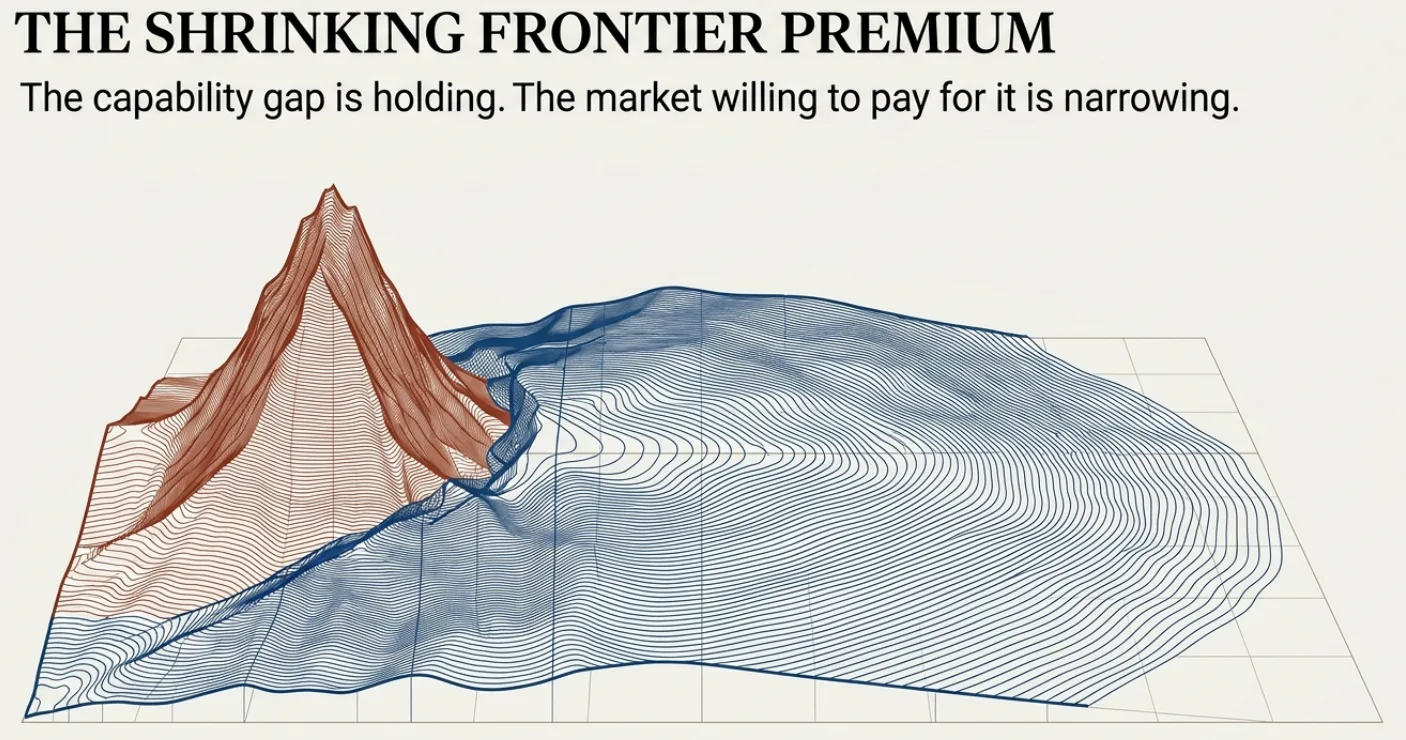
This is the tension defining the model market. OpenAI and Anthropic may preserve a rolling four-to-six-month capability lead by continuing to move the frontier. What they may struggle to preserve is the number of tasks — and tokens — for which customers will pay frontier prices.
GLM-5.2 Crossed the Threshold That Matters
Most launches arrive with the same ingredients: a benchmark table, a few cherry-picked comparisons, and a claim of being faster, cheaper, or smarter than whatever came before. GLM-5.2 has those — Artificial Analysis ranks it the leading open-weights model on its Intelligence Index, and it reached second on the Code Arena WebDev leaderboard behind only Claude Fable 5.
But the more important evidence came from people using it. Vercel CEO Guillermo Rauch described himself as “almost shocked” by its coding ability. Former Meta, DeepMind, and Microsoft executive Matt Velloso called it the first open model that cleared the bar as a daily driver. AI researcher Nathan Lambert called it the first open model that feels right as a general agent inside coding harnesses.
That is a different threshold from scoring well on a benchmark. A model becomes economically relevant when a developer is willing to substitute it for something they already depend on — and GLM-5.2 appears to be one of the first open models that can plausibly replace a recent Claude or OpenAI model for a meaningful share of agentic coding work.
Not all of it. It does not need to.
If an open model can handle a meaningful share of production tasks at a much lower price, the closed model has to justify its premium on the remaining work. That changes procurement even if the frontier model remains clearly better at the hardest tasks.
The Real Frontier — and How Close GLM-5.2 Gets
To see why this matters, look at the model GLM-5.2 is chasing.
Anthropic launched Claude Fable 5 on June 9, and it immediately topped the Artificial Analysis Intelligence Index at 64.9, nearly five points clear of the best non-Anthropic system. It is priced accordingly: $10 per million input tokens and $50 per million output, more than eleven times GLM-5.2’s output price.
Three days later, the US government ordered Anthropic to suspend access to Fable 5 and Mythos 5 for every foreign national, including its own employees. Anthropic disabled both models globally because it could not comply selectively, while disputing the government’s concern over a narrow jailbreak.
The highest-scoring model on Artificial Analysis disappeared from the market seventy-two hours after launch. For most developers, the practical frontier became whatever they could actually run.
Against that bar, GLM-5.2 is closer on some ordinary workflows than the fourteen-point Intelligence Index gap suggests. On a planning benchmark the two finished 9.0 to 9.1; on a human-judged web-design arena GLM-5.2 edged ahead, 1,360 Elo to 1,350. On the harder, agentic SWE-bench Pro it still loses clearly. Narrow tests like these are not broad parity, but they matter because customers buy models for particular jobs, not a composite score.
Frontier intelligence still wins the hardest tasks, and buyers will pay for it there. But on a growing share of ordinary work, the open model is becoming good enough at a fraction of the cost. The frontier lead can hold while the market that requires it narrows.
There is one more asymmetry the directive exposes. Fable 5’s lead did not diffuse away — access was switched off. Released weights are harder to recall. Once GLM-5.2 shipped openly and copies began circulating, no single provider could withdraw it globally. Closed access can be revoked; open weights persist.
The Token Paradox
The phrase “cheap open model” creates the wrong mental picture. GLM-5.2 has 753 billion total parameters, roughly 40 billion active per token through its mixture-of-experts design, and full weights of about 1.51 terabytes — with a context window that jumped from 200,000 tokens in GLM-5.1 to one million. This is not something most companies will run locally on a workstation. The weights are open; the infrastructure required to serve them remains industrial.
That matters because a low access price does not prove low compute. OpenRouter providers offered GLM-5.2 at around $1.40 per million input tokens and $4.40 per million output — against $5 and $30 for GPT-5.5, and roughly $5 and $25 for recent Claude Opus models. The sticker-price gap is enormous. But price per token still does not tell us what a completed task costs.
Artificial Analysis found that GLM-5.2 used roughly 43,000 output tokens per Intelligence Index task — about 65% more than GLM-5.1, nearly 80% more than MiniMax M3, and more than any of its leading open competitors. The model improved its results partly by spending more inference on each problem.
That does not make it unattractive. At $4.40 per million output tokens, 43,000 tokens cost about $0.19. The same work billed at Claude Opus’s $25 per million — even at a leaner 24,000 tokens — runs around $0.60, before input, caching, or retries. Not a like-for-like task comparison, but enough to show GLM-5.2 can be both more token-hungry and substantially cheaper.
This is the next stage of the token-pricing problem. Price pages already fail to capture tokenizer differences, reasoning configurations, context management, tool calls, and retries. GLM-5.2 adds another variable: a low-priced model can still be extremely compute-intensive because it reasons at greater length.
The economic unit is not price per token. It is:
Cost per successful task = token price × tokens consumed × attempts required
Even that leaves out latency, human supervision, and infrastructure utilisation. But it is closer to what enterprises actually buy.
Why Cheaper Models Lead to More Consumption
The immediate reaction to cheaper models is that they weaken the infrastructure thesis: if GLM-5.2 delivers frontier-adjacent coding at a fraction of the price, perhaps companies need fewer GPUs and the hundreds of billions going into data centres earn lower returns. That could hold for an individual task. It is less convincing for the whole system.
Lower prices expand the number of tasks worth attempting.
A company that could justify one expensive coding agent can run five cheaper ones in parallel. A developer can send an agent after low-priority bugs, internal tools, documentation, test coverage, migrations, and abandoned backlog work. Failed attempts become less costly. Longer contexts become easier to justify. More users gain access in markets where a $100 or $200 monthly subscription was prohibitive.
And the nature of the work expands. A 200,000-token model inspects a slice of a repository; a usable one-million-token model invites teams to load entire projects — code, specs, logs, deployment configs — into one workflow. Once that capacity exists, products get designed to consume it.
The Jevons effect is not automatic. Efficiency does not guarantee that total resource consumption rises. But AI has shown the pattern repeatedly: lower costs are reinvested into longer contexts, more reasoning, more agents, and more attempts rather than banked as savings.
Fewer dollars per token. More tokens per worker.
The DeepSeek Moment That Didn’t Come
When DeepSeek’s R1 arrived in January 2025, the market treated it as an attack on the entire American AI build-out. Nvidia lost close to $600 billion in a single session — the largest one-day wipeout in market history — on the theory that a cheap Chinese model meant the West had overbuilt. Efficiency, the panic went, would gut the demand for compute.
GLM-5.2 is more competitive against today’s frontier than R1 was against the frontier of early 2025. It scores 51 on Artificial Analysis’s Intelligence Index — fourth in the world, behind only Claude Fable 5, Claude Opus 4.8, and GPT-5.5, and first among open models by a wide margin. Yet the broad market barely moved when the weights were released.
The muted reaction is the most interesting market data point of the launch.
Part of it is simple repetition. DeepSeek was the repricing event. The market already learned in 2025 that a Chinese lab could sit near the frontier, so GLM-5.2 reads as confirmation, not surprise. You do not get a second panic over the same fact.
The deeper reason is the thesis of this piece. The efficiency-kills-demand trade did not play out as the market first feared. In the eighteen months after R1, capex did not fall — it climbed. That does not prove cheaper models caused the build-out, but it is consistent with the Jevons dynamic: falling inference costs pulled more workloads into reach while agents and longer reasoning increased total consumption. A cheaper, more capable open model is no longer obviously bearish for the companies selling compute.
Where enthusiasm did show up immediately was the developer’s own stock. Knowledge Atlas — the Hong Kong-listed entity behind Z.ai — nearly doubled in a week to a brief HK$1 trillion valuation, trading around HK$2,400 by June 24, roughly 21 times its January IPO price. On 2025 revenue of RMB724 million and still loss-making, that is a momentum-driven re-rating as much as a verdict on the business.
The Frontier Lead Can Survive While Its Premium Shrinks
The strategic problem for frontier labs is not that GLM-5.2 has caught up. It has not. Anthropic and OpenAI still lead where it is hardest — long-horizon tasks, cybersecurity, reliability under ambiguity, multimodal capability, and enterprise deployment. GLM-5.2 is also text-only, and informal tests show it unevenly, strong on some generations and worse than GLM-5.1 on others.
Closed labs introduce a new capability tier. Four to six months later, the strongest open models approach it, but by then the closed labs have moved again. If that cadence holds, the frontier labs can maintain their monopoly over the highest-value capability indefinitely.
China breaking that cycle would require shortening the lag, not merely matching the previous generation — and that looks difficult while its labs build around restricted access to the most advanced hardware. Algorithmic efficiency, domestic chips, and open research can narrow the gap, but none has yet let Chinese labs release at the same frontier and cadence as the leading US labs.
The economic pressure arrives before full technical convergence. The relevant measure is therefore not the size of the capability lead but how much demand stays attached to it as the previous tier becomes cheap. A six-month lead can be technically durable and economically less valuable at once: frontier labs keep the hardest problems and highest-value customers while losing routine inference to open models. The monopoly survives at the top; the premium just applies to a smaller share of total tokens.
That is why GLM-5.2 does not mean OpenAI or Anthropic are finished, only that selling raw intelligence through an API is becoming a less complete business model. The durable advantage moves to what surrounds the model — distribution, the agent harness, enterprise trust, and the next capability nobody else has yet.
And a deeper asymmetry works against the closed labs. The leader pays to discover what works; the follower only has to observe where the value appeared — then benchmark the frontier lab’s own outputs, target the same use cases, and train on them. (American labs call some of this distillation; the extent is contested.) The two are not even playing the same financial game: the frontier lab must recover fixed costs and fund the next run, while an open-model provider can price for adoption, national strategy, or future enterprise conversion. Price competition is therefore especially punishing for closed labs — their competitors do not need to reproduce the full frontier, only get good enough to absorb the large middle of the market.
GLM-5.2 is evidence of that pressure — not China erasing the frontier gap, but the model several months behind it already competing for a far larger pool of work than any previous open release.
What Could Break This Thesis
The early enthusiasm around GLM-5.2 may not survive production use. Benchmarks can be optimised, and launch-week reactions select for surprising successes; long-running agents expose reliability failures short demos miss. If GLM-5.2 needs more supervision, retries, or cleanup, its cost advantage narrows.
Infrastructure matters too. A 1.51TB model is open but not operationally free, and many companies will still pay a managed provider rather than build the serving, security, and monitoring stack themselves.
The frontier could also accelerate again. A capability jump large enough that cost becomes secondary — one model that can reliably complete a ten-hour engineering task — makes price per token nearly irrelevant for high-value work.
The opposite would be more threatening to the frontier labs: China could shorten the four-to-six-month lag. If GLM’s successors arrive only weeks behind the leading US models, the period of scarcity may become too short to sustain current premiums. Given China’s frontier-compute constraints, that is not the base case. It is the clearest disconfirmer.
Finally, geopolitics could split the market. A model can be technically open and economically attractive while remaining unusable for government agencies or sensitive Western enterprises.
GLM-5.2 has demonstrated a possibility, not a completed market transition.
What We Are Watching
Real task economics. Independent evaluations should publish tokens, retries, latency, and completion rates together — how much inference it takes to complete a unit of useful work, not just a benchmark score. That number, and whether it falls faster than usage expands, matters more than price per million.
Production adoption. Launch-week praise is useful. Sustained OpenRouter share, enterprise deployments, and integration into coding products would be stronger evidence that GLM-5.2 is replacing closed-model workloads.
The closed-model response. Watch whether OpenAI and Anthropic lower prices, bundle more usage into subscriptions, or move further into managed agent infrastructure. Price cuts would confirm pressure. More vertical integration would show where they believe the moat is moving.
The open-model lag. Not whether a Chinese model reaches the previous frontier, but how many months separate its release from the latest US tier. A sustained move from four-to-six months toward weeks would break the rolling-monopoly thesis.
GLM-5.2 does not prove China has won the model race. The leading US labs may hold a four-to-six-month lead for years by continuing to move the frontier, charging a premium where performance, trust, and reliability matter.
But the pricing clock starts immediately. Every breakthrough creates a target; every expensive capability eventually becomes a cheaper product. The leaders can always release the next one — but the premium concentrates in the newest, hardest work instead of applying across the whole market.
The result is a strange market: intelligence keeps getting cheaper while the appetite for computation keeps growing.
GLM-5.2 is not the end of the frontier. It is evidence that being behind it matters less than it used to.
This is part of an ongoing series on AI infrastructure economics. Earlier pieces covered the physical bottleneck sequence, the memory demands created by agentic work, the model race as an inference-demand engine, and why price per token no longer reflects the cost of completing a task.
For more on the AI stack and where value flows, visit theupcurious.com.