
Two and a half weeks after Meta launched Muse, its personal AI agent, Amazon has blocked it, Expedia has signed up to work with it, and Meta has added roughly $420 billion of market value. Most commentary still asks whether Muse beats ChatGPT. For investors, the sharper question is who gets paid when an agent does the buying.
The answer depends on where the agent sends the transaction, and on who lets it in.
What Muse Is
Meta launched Muse on September 8 as a personal agent for US adults. It sends email, books travel, fills in forms and shops. Each user gets a dedicated cloud computer, built by Meta, with its own browser, running Meta’s in-house Muse Spark model. Sensor Tower data cited by Reuters put downloads at 2.8 million in two weeks, and Muse passed ChatGPT as the top free app in the US and Canada. Its closest rival, Google’s Gemini Spark, can also browse, compare and help complete bookings, but is limited to paying Google AI Pro and Ultra subscribers.
A separate agent, Sentinel, checks every outbound action against policies the user sets, allowing it, blocking it or asking for approval. Muse cannot see passwords or payment details.
The access picture split quickly. Checkout runs through Stripe’s Link, and Shopify announced Shop Pay checkout inside Muse on September 21. By the night of September 20, Amazon had cut Muse off, saying third-party apps that buy on a customer’s behalf should “operate openly and respect service provider decisions.” Amazon says it is in direct conversation with Meta.
The business model is still forming. Reuters reported a free tier with paid plans at $20 and $100 a month. At Meta Connect on September 23, Zuckerberg said Muse would remain free for substantial usage, with Meta expecting to profit over time from a small fee on transactions. He did not disclose the rate or who would pay.
The Layer Map
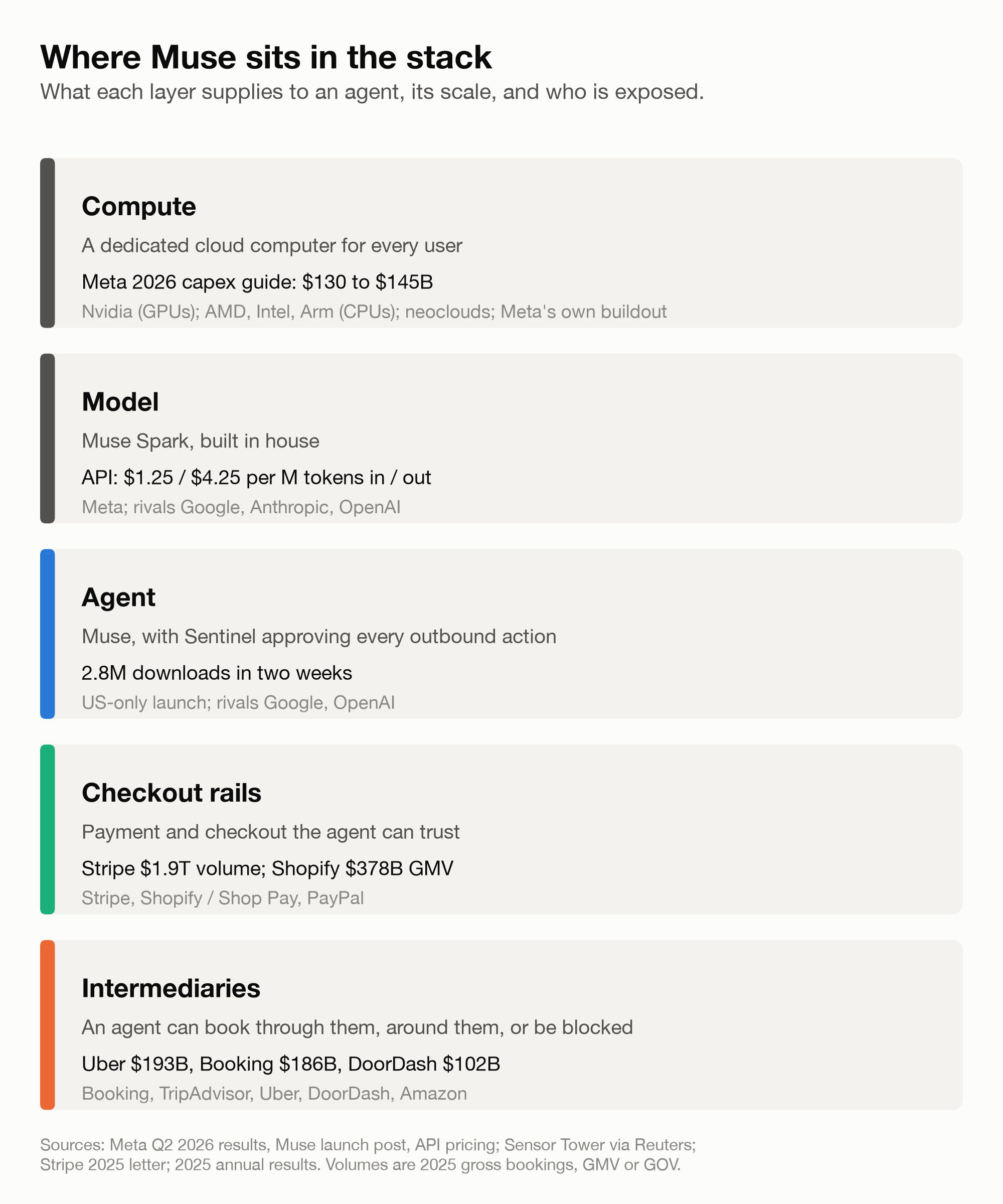
2025 volumes. Sources: capex guide, Meta Q2 2026 results; model pricing, Meta API; downloads, Sensor Tower via Reuters; Stripe 2025 letter; Shopify 10-K; Uber, Booking and DoorDash annual results.
Three Paths for a Transaction
Booking spent $8.2 billion on marketing in 2025, about 30% of its revenue. Its 10-K ties the efficiency of that spend to “costs per click” and the bidding environment, which means much of it buys traffic in paid channels such as search. Not all of it is search, and none of it is profit waiting for Meta to collect. But it is the pool an agent competes for: money a company already pays to bring a customer to the door.
Suppose a Muse user asks for a hotel in Lisbon. The booking can go three ways, and each has different winners.
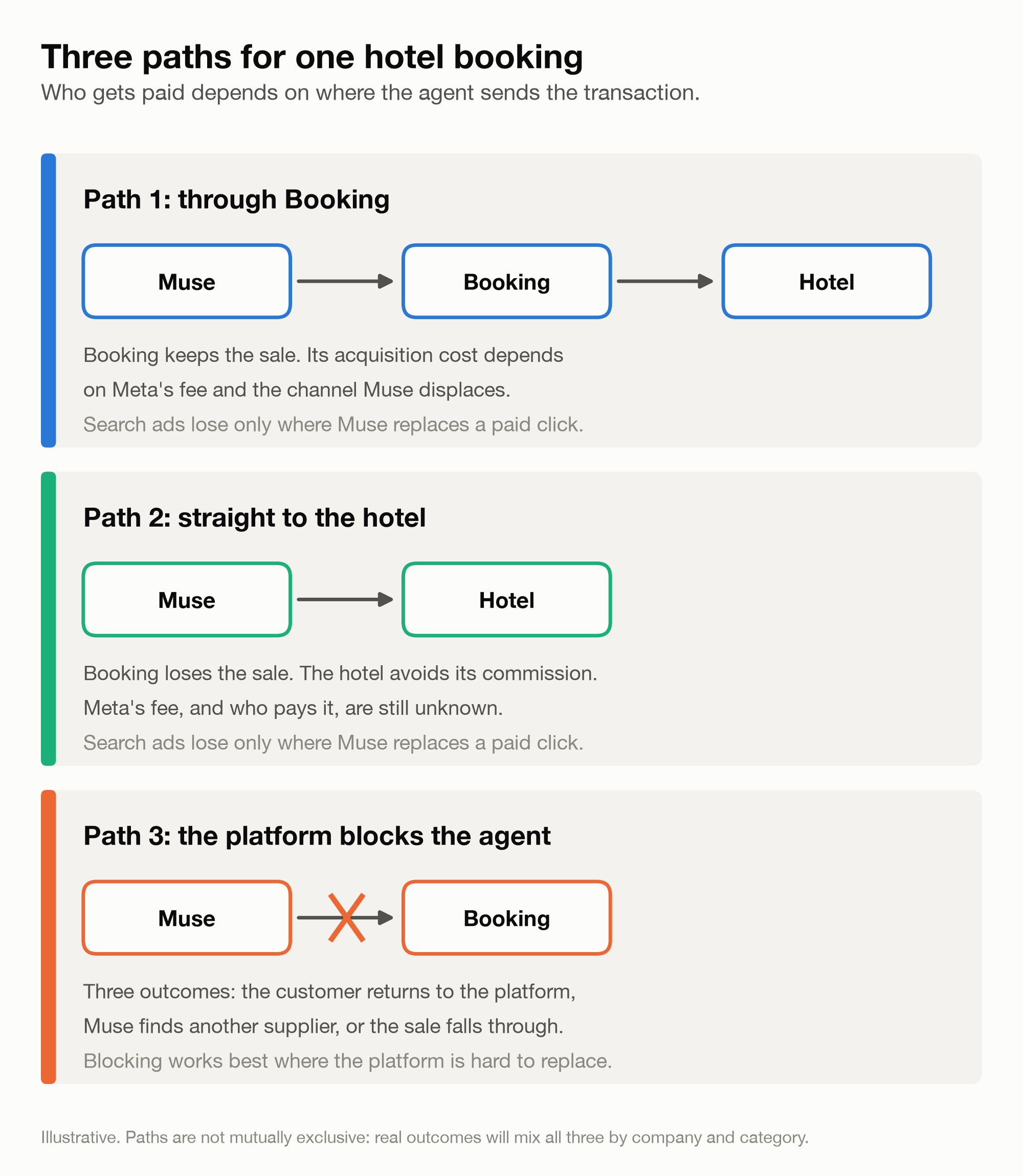
Path 1 depends on which customer Muse replaces. If Muse replaces paid search and lowers Booking’s acquisition cost per completed booking, Booking gains. If it charges Booking for a customer who used to come direct, that is a new cost, and it weakens the relationship Booking uses to build loyalty and repeat bookings.
Path 2 bypasses Booking, but execution is harder. Booking’s inventory does not protect it, since the hotel provides the room either way. Direct booking depends on reliable access to enough hotels, and aggregators already simplify that access.
Path 3 depends on how replaceable the platform is. Amazon took this path. Where substitutes are available, blocking risks losing the sale. Where the platform is hard to replace, blocking strengthens its bargaining position.
Real outcomes will mix all three, by company and by category. The investment question is which path dominates where. The first evidence came fast. At Connect, Meta announced retailers such as Walmart and Sephora as live partners, Instacart for groceries, PayPal alongside Shop Pay, and Expedia “coming soon” for travel. Expedia, a travel intermediary, is choosing Path 1. Amazon chose Path 3. Booking, Uber and DoorDash have not yet said which they prefer.
The Checkout Rails
A checkout provider is needed on every path that completes a purchase, but that does not make the rails winners. A purchase delegated to Muse may use the same payment provider as before: the interface changes, the payment volume does not. For the rails to gain, one of three things has to happen:
- Incremental purchases. Agents make buying easy enough that people buy more. Unproven.
- Share gains for integrated providers. Stripe Link, Shop Pay and PayPal are Muse’s integrated payment options. If agent checkout routes toward them, they take volume from providers that are not integrated. This is the most defensible mechanism so far.
- New monetization. Rails charge merchants or Meta extra for agent-initiated checkout. No terms have been published.
The Compute Read
In the second quarter, Meta spent $31.1 billion on capital expenditure and generated $784 million of free cash flow. Until this month, the clearest return on that buildout was better ad ranking. Muse is the clearest consumer product yet that could turn it into a new revenue line.
Its compute needs depend on usage. An agent does two kinds of work. Running the model happens mainly on GPUs. The rest, such as operating the browser, running code and coordinating each step of a task, happens mainly on CPUs. Even NVIDIA’s reference architecture for AI data centers separates the two. Demand depends on active users, task frequency and work per task, not simply on the number of cloud computers assigned.
CPU makers have moved most. From Muse’s launch to the September 24 close, AMD rose 24%, Intel 22% and Arm 17%, while Nvidia, which also sells data center CPUs, was flat. CNBC linked the biggest day, September 21, partly to Muse, but notes tight CPU supply was already a story this spring and that session also carried Middle East news. Muse sharpened an existing thesis rather than creating it. Nebius gives one concrete pricing signal: from October 1 it is raising starting rates for CPU-only instances by 20% to 30%, alongside 17% to 21% on selected GPU instances. That is one provider’s list prices, not proof of a market-wide rise.
Neoclouds sit on both sides of Meta, and their shares have not joined the rally: CoreWeave fell 10% and Nebius was flat from Muse’s launch to September 24. Meta is a major customer. Its Nebius agreement comprises $12 billion of dedicated capacity plus up to $15 billion that Meta buys as a backstop for capacity other customers do not take, and CoreWeave added $21 billion in April. Both were signed before Muse’s public launch.
Meta may also become a competitor. On the July call, Zuckerberg said Meta expects to “grow a large business serving large customers” with its compute, and a Bloomberg report of a Meta cloud business in July knocked CoreWeave and Nebius down 14% and 17%. If Muse disappoints, Meta could have more capacity to sell into their market, though other Meta workloads could absorb it.
What the Rally Hasn’t Proved
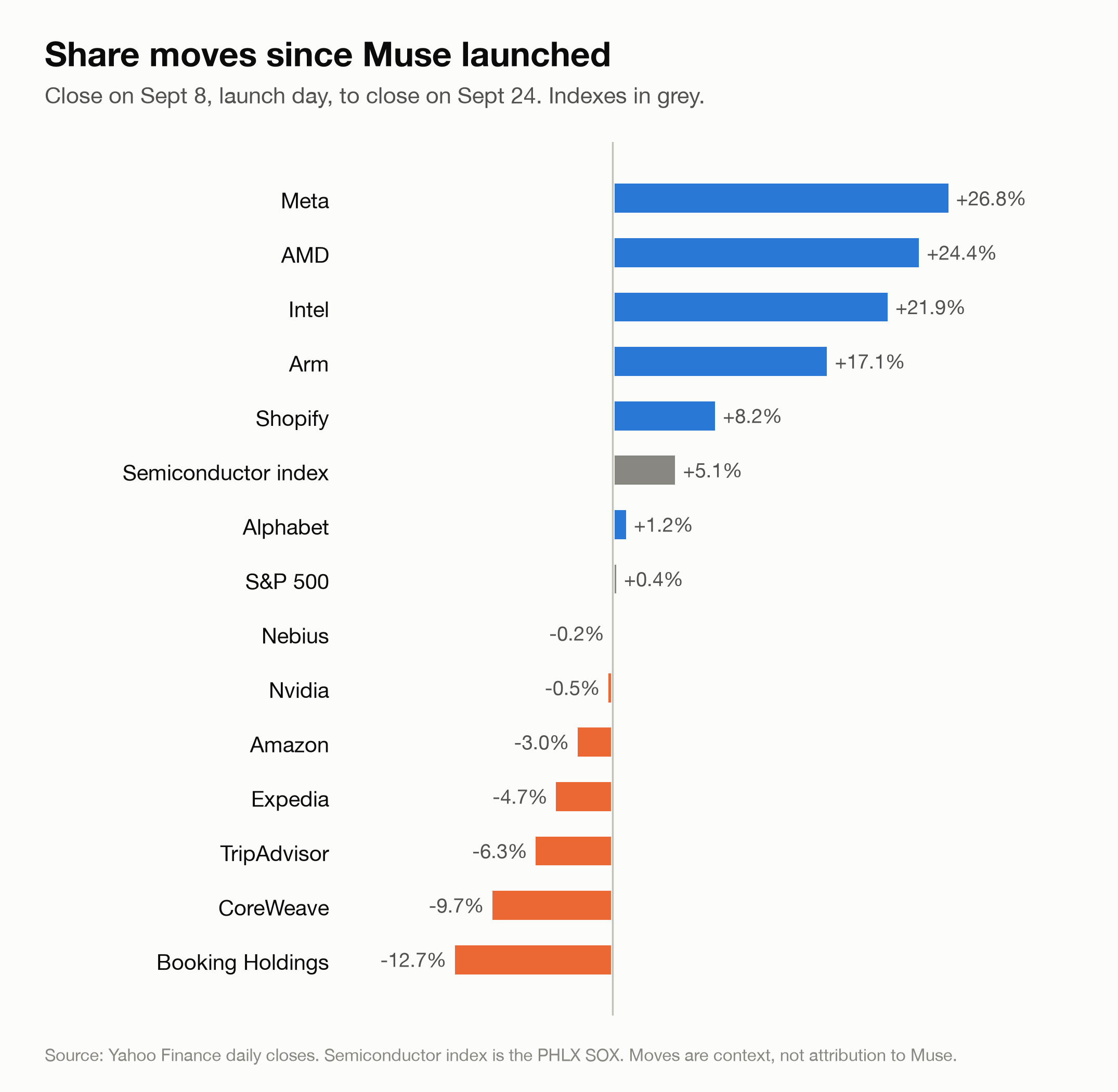
Meta rose 27% from Muse’s launch to the September 24 close, against 0.4% for the S&P 500, per Yahoo Finance prices, after a 13% run from its August 18 low. On the share count in Meta’s latest 10-Q, the gain is roughly $420 billion of market value. Expedia fell 5% despite its planned integration. The moves are context, not a measurement of expectations. Our hypothesis is that investors are treating Muse as a distribution option for Meta and a Path 2 risk for travel intermediaries.
Adoption is where the evidence is strongest. Sensor Tower estimated about 560,000 daily active users after 11 days, Yahoo Finance reported. Yahoo’s test found Muse gathering moving quotes and booking a restaurant, but also inventing a phone number and recommending a restaurant that had closed. These third-party estimates suggest substantial early daily usage. What remains unproven is sustained retention, purchase volume and revenue per active user.
Wells Fargo raised its target from $640 to $796 by lifting its multiple from 20 to 25 times 2027 earnings, while trimming its 2027 earnings estimate slightly and leaving revenue unchanged. KeyBanc, by contrast, cited higher forecasts but did not publish them. Wells Fargo’s revision illustrates investors paying more for future AI potential before it appears in near-term earnings forecasts. It does not say how much of Meta’s gain belongs to Muse.
Alphabet’s reaction has been smaller than it looked on Wednesday. It fell 3.8% on September 23, but the shares rose 1% from Muse’s launch to September 24. Google Search and other revenue was $63.3 billion in the second quarter, still growing 17%. Muse would need to replace paid searches across many categories before that line shows it, and Google has Gemini Spark and a Gemini 4 that DeepMind’s chief says will arrive “much earlier” than year end.
What Would Break the Thesis
The product does not work reliably. Meta employees testing Muse in launch week described “many failure modes that made it unreliable,” Reuters reported, as carried by Forbes. Meta’s vice president of AI products said the extra months got Muse to “the minimum bar” for release. Purchase errors carry direct financial consequences: a refund, a complaint and possibly a lost user.
Early usage does not become habit. Daily-usage estimates cover Muse’s first weeks, when novelty is highest. Whether people delegate real purchases a second and third time is undisclosed.
Amazon’s choice becomes the norm. If Booking, Uber and DoorDash follow Amazon, Muse is left with the partners that choose it, a list that already runs from Walmart to Expedia. That is a real business, but narrower than an agent that can buy anywhere.
The fee does not cover the cost. Zuckerberg said Muse will stay free “for a huge number of tokens”. Muse pays back only if subscriptions and transaction fees cover infrastructure and operating costs, including failed tasks.
What We Are Watching Next
- Meta’s third-quarter results. Muse usage, revenue and capex guidance, separating operating performance from the $10 billion legal charge Wells Fargo expects in the quarter.
- Platform access. Whether Booking, Uber and DoorDash partner, restrict access or block agents.
- Completed bookings. Agent-attributed transactions, the acquisition channels they displace and acquisition cost per booking.
- Transaction fees. The rate, who pays and how much Meta keeps after costs.
- Google’s response. How it prices and distributes Gemini Spark, and any evidence of commercial queries shifting to agents.
This article is for informational purposes only and is not investment advice. The author may hold positions in companies mentioned.