Micron is using the best quarter in its history to lock in multi-year revenue, signing take-or-pay contracts with price floors in exchange for limits on some of its upside. It is doing so as its own numbers show price growth cooling and customers adjusting to tight supply and rising costs.
Revenue for fiscal Q4, reported September 30, was $54.2 billion, up 31% from the prior quarter and 379% from a year ago. Adjusted gross margin was 87.0%. Fiscal 2026 revenue was $133.2 billion, three and a half times the prior record.
The other number to know is about $150 billion: Micron’s contracted minimum revenue, counting committed volumes at minimum prices and only for agreements with a defined pricing framework. In June, 14 of its 16 agreements carried about $100 billion on the same basis. It now has 26, and some run into 2031.
The stock closed at $1,065 ahead of the report and slipped about 1% after hours, with coverage pointing to the capex plan. On October 1 it closed at $1,097, about 3% above its pre-report close.
The Earnings, Quickly
- Revenue: $54.2 billion, above guidance of $50 billion plus or minus $1 billion and the consensus of $51.1 billion cited by CNBC and Schwab. Adjusted EPS of $33.42 beat $31.61.
- Next quarter: revenue guide of $61.5 billion against about $57 billion expected, and adjusted EPS of $38.15 against about $35.40. Both beats.
- Adjusted gross margin guide: about 86.25%, down from 87.0%. Management calls it the low point for fiscal 2027, caused by higher employee bonuses absorbed into inventory.
- Cash: adjusted free cash flow of $33.2 billion for the quarter; net cash of $68.3 billion.
Customer deposits are not in that free cash flow. Micron received $12.3 billion this quarter and holds $12.7 billion, reported as financing and owed back toward the end of each agreement if customers meet their minimums. The $32 billion in the headlines is total customer commitments, not cash Micron keeps.
Management’s outlook is bullish. It expects fiscal 2027 to be another record year, with revenue rising every quarter, and supply-demand conditions “much tighter in calendar 2027 and 2028” than in 2026.
Where the Money Came From
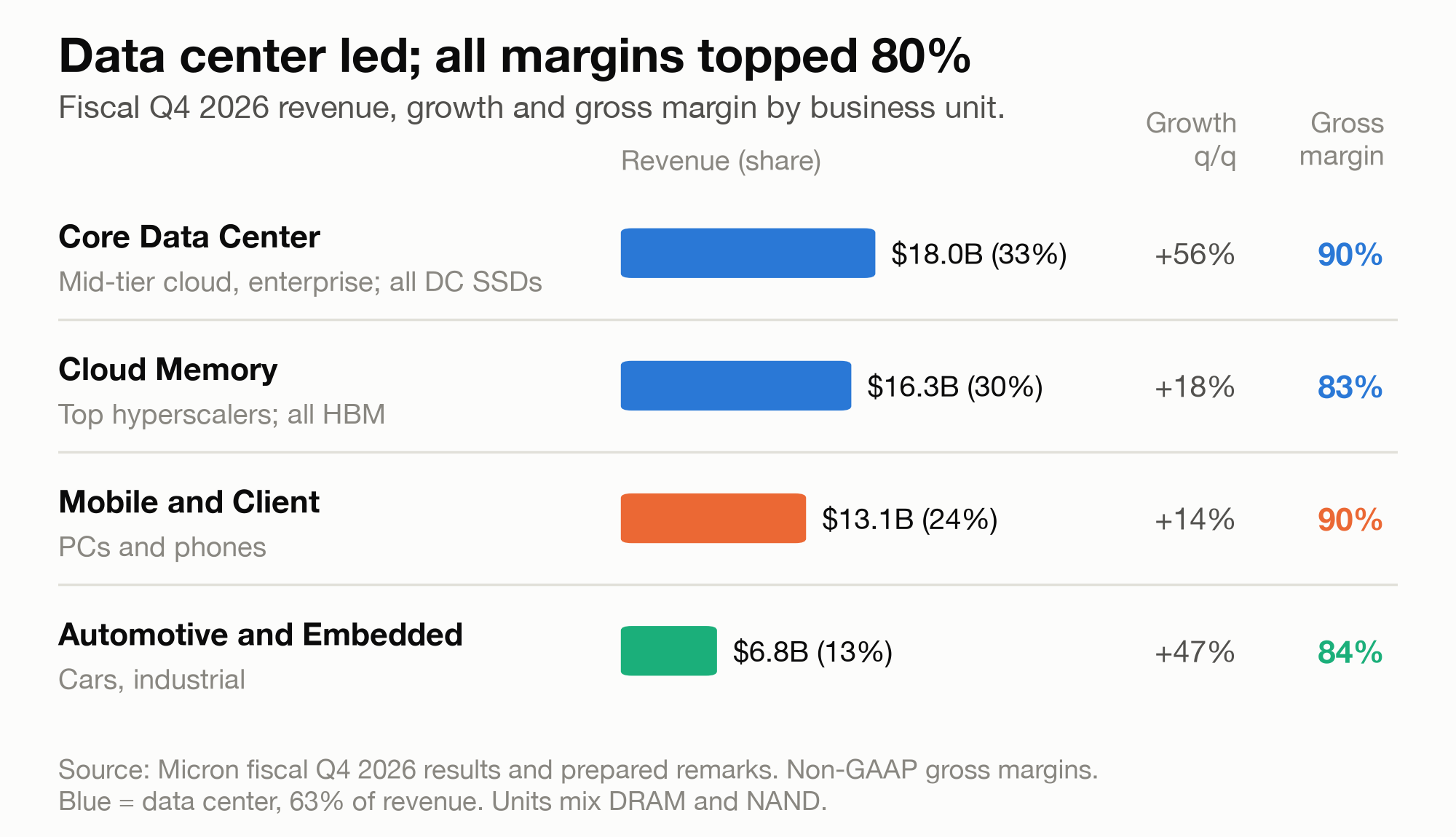
Data center units were 63% of revenue. Core Data Center, which serves mid-tier clouds, enterprises and OEMs and sells SSDs to every data center customer, grew 56% in a quarter. Cloud Memory, which serves the largest hyperscalers and holds all HBM, grew 18%.
At Micron, HBM carries a lower gross margin than conventional DRAM. Cloud Memory’s gross margin was 83%, against 90% in Core Data Center, held back by “higher HBM mix.” The units mix DRAM and NAND, so this is not a clean product comparison, but it matches Micron’s own wording: it has agreed most 2027 HBM supply at significantly higher prices, “narrowing the gross margin gap with conventional DRAM.” The shortage reaches well beyond HBM into conventional DRAM, though margin gaps alone do not show which product drives industry profits.
Micron earns the same gross margin in Mobile and Client as in Core Data Center. Mobile and Client revenue rose 14% while bits (memory capacity shipped) fell, and Micron expects PC and phone units could fall by double digits this year. Consumers are not driving this cycle, but their memory is priced off the same shortage.
NAND is 26% of revenue and grew fastest, up 42% sequentially. Data center SSDs brought in nearly $10 billion, over two thirds of NAND revenue, helped by offloading some cached data used during AI inference to SSDs (“KV cache offload”), and by replacing hard drives.
Why the Contracts Matter
Micron is locking a growing share of future revenue into long-term agreements, which are take-or-pay: customers commit to volumes for years and pay whether or not they take them. Micron estimates they cover over 35% of its revenue through 2030. About three quarters of the contracted revenue has fixed prices or a band with a floor and a ceiling; the rest reprices at market.
- The floor. Micron expects margins at floor prices to be “meaningfully above any prior cycle peak margins.” That is management’s expectation, not a guarantee: a floor protects price, while margins still depend on costs, utilization and customers meeting their commitments.
- The ceiling. Micron disclosed in June that its largest agreements generally cap prices for existing products near calendar Q2 2026 market levels. Prices have risen since, which suggests some of that business may now be near its ceiling.
Keep both in proportion. Just over a quarter of expected revenue through 2030 has fixed or banded prices, an estimate across the period rather than a fixed share of each quarter. Most of Micron’s revenue still moves with the market, and Micron says new agreements are being signed at higher prices.
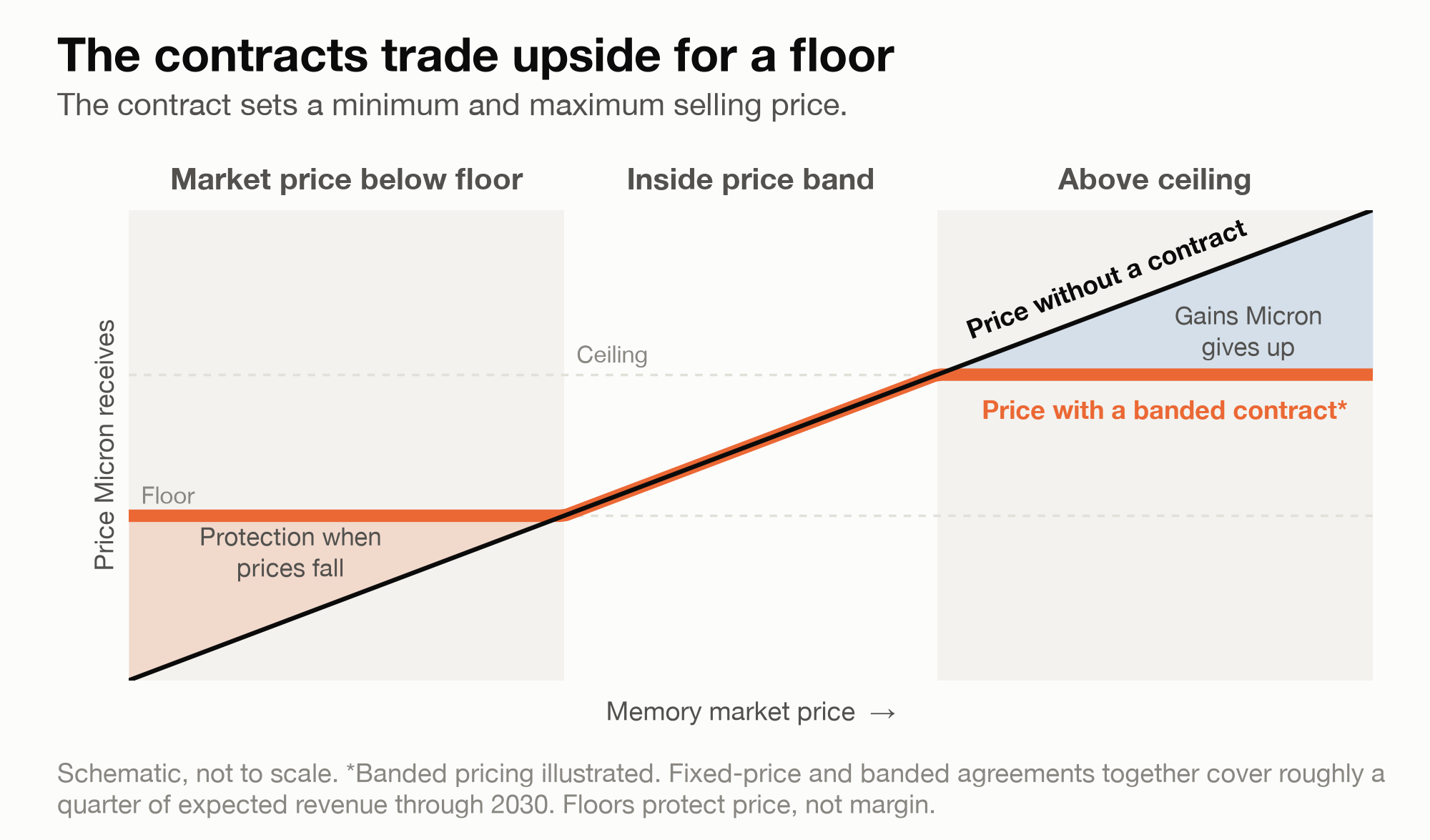
If the shortage holds, which is Micron’s stated view, market-priced revenue keeps repricing up, and the contracts cost Micron some upside on the capped slice.
If prices plateau, with stable mix, growth depends mainly on how much memory Micron ships, and margins on costs and utilization.
If demand cools as new fabs open, market-priced revenue reprices down while floors cushion prices on the contracted slice. Most revenue stays exposed.
Why Agents Need More Memory
Micron attributes rising memory content to “growing model parameter size, longer context lengths and higher concurrency.” AI agents push on the last two, and three always-on agents reached the market in August and September:
- Meta’s Muse launched September 8, giving each user a dedicated cloud computer, and reached 2.8 million downloads in two weeks, according to Sensor Tower data cited by Reuters.
- xAI’s Grok Bot, aimed at workplace tasks, had 418,000 weekly users a month after launch, up 24% in a week.
- OpenAI’s dots, launched September 29 for paying ChatGPT subscribers, get their own cloud computer and browser and learn a user’s preferences over time.
A chatbot answers one question and stops. An agent works through many steps, carries a growing record of the task and keeps running in the background, so more sessions stay live at once. That record, the KV cache, sits in HBM and DRAM, and the overflow increasingly goes to SSDs, the offload already lifting Micron’s data center SSD sales. Each agent’s own computer also runs on conventional servers with ordinary DRAM. Agents therefore lean on conventional DRAM and SSDs, not just on HBM.
How much this adds is unknown. No company discloses memory per agent, and usage is early: Grok Bot had fewer than half a million weekly users in mid-September. Agents raise memory demand most if they become a daily habit, and the same costs that make them memory-hungry give buyers a reason to economize.
Buyers Are Adjusting
Sustaining today’s margins requires buyers to keep accepting elevated prices; sustaining pricing-led growth requires them to accept further increases. TrendForce estimates memory at 47% of cloud providers’ total capex in 2026 and 68% in 2027.
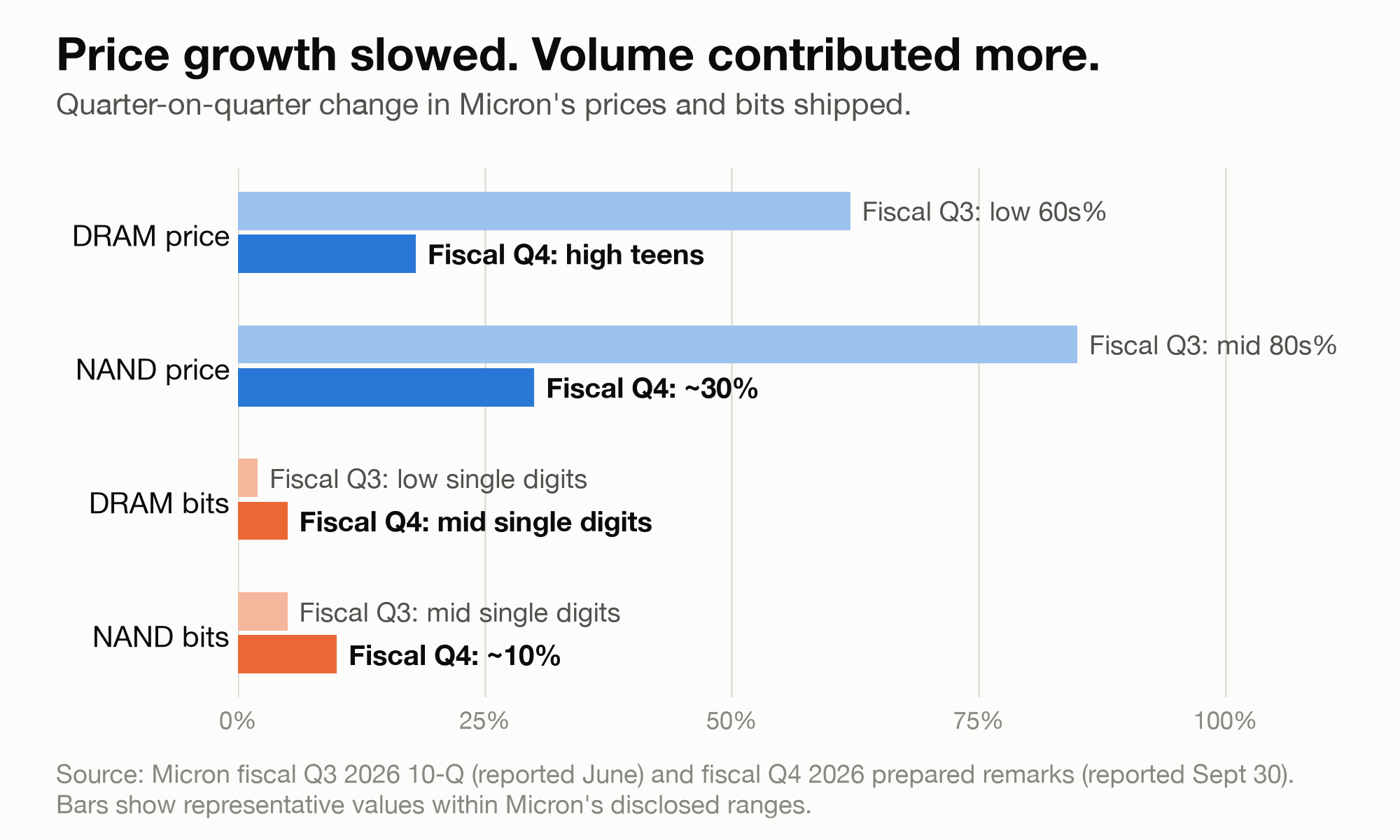
Micron’s own numbers show the shift. DRAM price growth fell from the low 60s percent in fiscal Q3 to the high teens in fiscal Q4; NAND fell from the mid 80s to about 30%. Volume contributed more, but pricing remained the main growth driver, and management guided to “a more moderate rate of price increases.”
On servers, Micron expects “a modestly lower rate of content growth than prior expectations, amid tight memory supply.” Content per server is still growing, just more slowly. Customers are adjusting configurations to constrained supply; rising costs may also be contributing. A TrendForce report on September 29 says AI chip makers are considering less HBM per device, citing “limited HBM supply and quickly increasing system costs.”
None of this says demand is weakening. Micron says demand strengthened since June and it has no “line of sight to when supply and demand will return to balance.” The point is narrower: buyers are shaping purchases around supply and cost, which makes contracts more valuable to Micron now than they might be later.
Capex and Who Pays
Coverage linked the after-hours dip to the higher spending plan. Micron guided about $25 billion for the first half of fiscal 2027 and more in the second, implying above $50 billion, against $27.4 billion in fiscal 2026, both net of government incentives as Micron reports them. Most of the increase is construction for cleanrooms in late 2028 and beyond, but Micron is also seeing “some pull-forward of equipment spending.” New fabs arrive from mid 2027, with Micron’s own additions bunching up in late 2028.
Micron is expanding supply while its customers commit ever more capital to AI infrastructure. The five largest buyers, including Oracle, are on track for more than $690 billion of fiscal 2026 capex. Debt is playing a larger role: FactSet compares the growth in these companies’ debt with their capex, and that ratio rose from 9% in fiscal 2024 to 32% in the year to mid-2026. It is not a precise funding share, and it hides differences: FactSet calls Oracle “the outlier” and puts the other four well below leverage levels that would threaten their credit ratings.
Beyond Micron
Micron’s pricing power is a cost elsewhere in the AI stack. SK Hynix and Samsung benefit from the same shortage, though their product mix and contract terms determine how much reaches earnings. Their next results will show whether Micron’s experience is reflected across the industry.
For accelerator makers, higher HBM prices can squeeze margins. NVIDIA showed that pressure directly last quarter: its CFO blamed a lower margin guide on memory costs. Chip makers are also considering lower-memory configurations to manage costs and limited supply.
Hyperscalers face the same constraint at the system level. At a given infrastructure budget, higher memory costs leave less for other components. They can spend more, accept fewer systems, or change configurations. Which response dominates will help determine how much pricing power memory suppliers retain.
Valuation and What Could Break It
At its October 1 close of about $1,097, Micron is worth roughly $1.25 trillion. Annualizing the fiscal Q1 adjusted EPS guide gives a run rate of about $153, or near 7 times. The multiple depends on sustaining unusually high earnings: EPS of $80, close to fiscal 2026’s $75.52, means 13.7 times; $40 means 27.4 times.
A multiple this low is consistent with the market treating these earnings as a cyclical peak, perhaps giving the floors little credit or fearing the capex plan. The contracts improve visibility on part of Micron’s revenue. Whether that deserves a higher valuation still depends on earnings from the much larger market-priced business. (This is analysis, not advice.)
Three developments would strengthen the case that memory earnings, at Micron and its peers, are near a peak.
- First, buyers could cut memory configurations because of cost, not just supply. That would be stronger evidence than a flat capex guide alone.
- Second, NAND could loosen. TrendForce expected in July a “more balanced” 2027, though its latest update shows enterprise SSD prices accelerating while client SSDs lag.
- Third, a credit event at the most leveraged buyers would impact memory demand without anyone changing their mind about AI.
What I’m Watching
- Hyperscaler results in late October: Does spending keep rising despite higher memory costs, and do they cite cost when they change memory configurations?
- Samsung and SK Hynix: Samsung’s preliminary figures in early October give a first look; full results later in the month should show whether pricing is strong across conventional DRAM and HBM. Faster capacity expansion would challenge how long the shortage lasts.
- Micron’s contract updates: Is more future revenue gaining price protection, and on what terms? Lower ceilings on comparable agreements, if disclosed, would suggest weaker bargaining power.
- Micron’s next quarter: Does NAND pricing remain strong, and is equipment spending accelerating? Softer prices alongside faster supply expansion would weaken the case for sustained high earnings.
For more on the AI stack and where value flows, visit theupcurious.com.